Hamilton County 2026 Property Values Rose 28%: What Actually Reaches Your Tax Bill
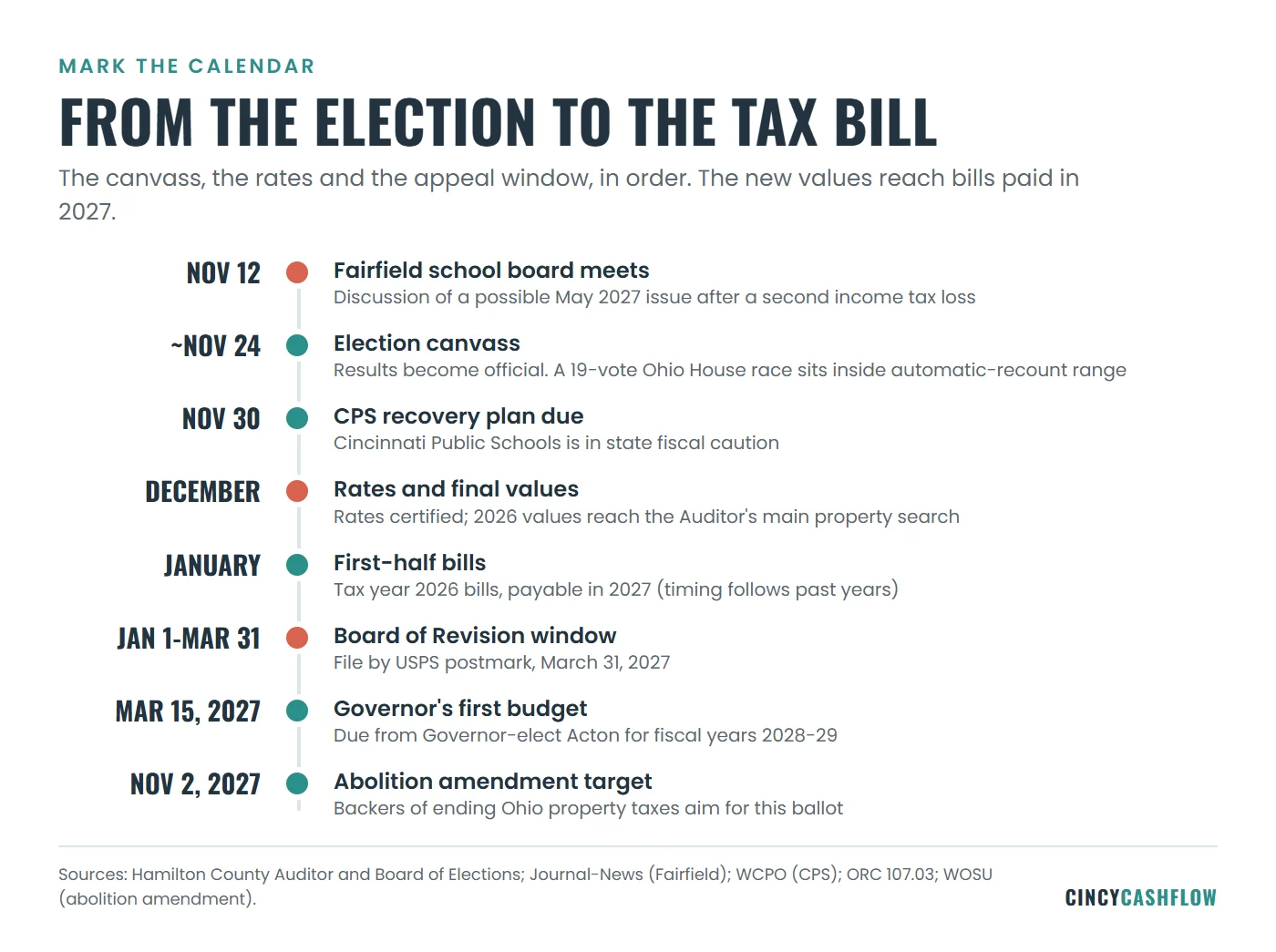
The Hamilton County Auditor finished its 2026 update, and the typical home's market value rose 28%. That figure is our analysis of every taxable one- to three-family home in the county, all 223,261 of them. It does not mean tax bills rise 28%. Rates get set in December, and the new values reach the bills paid in 2027.
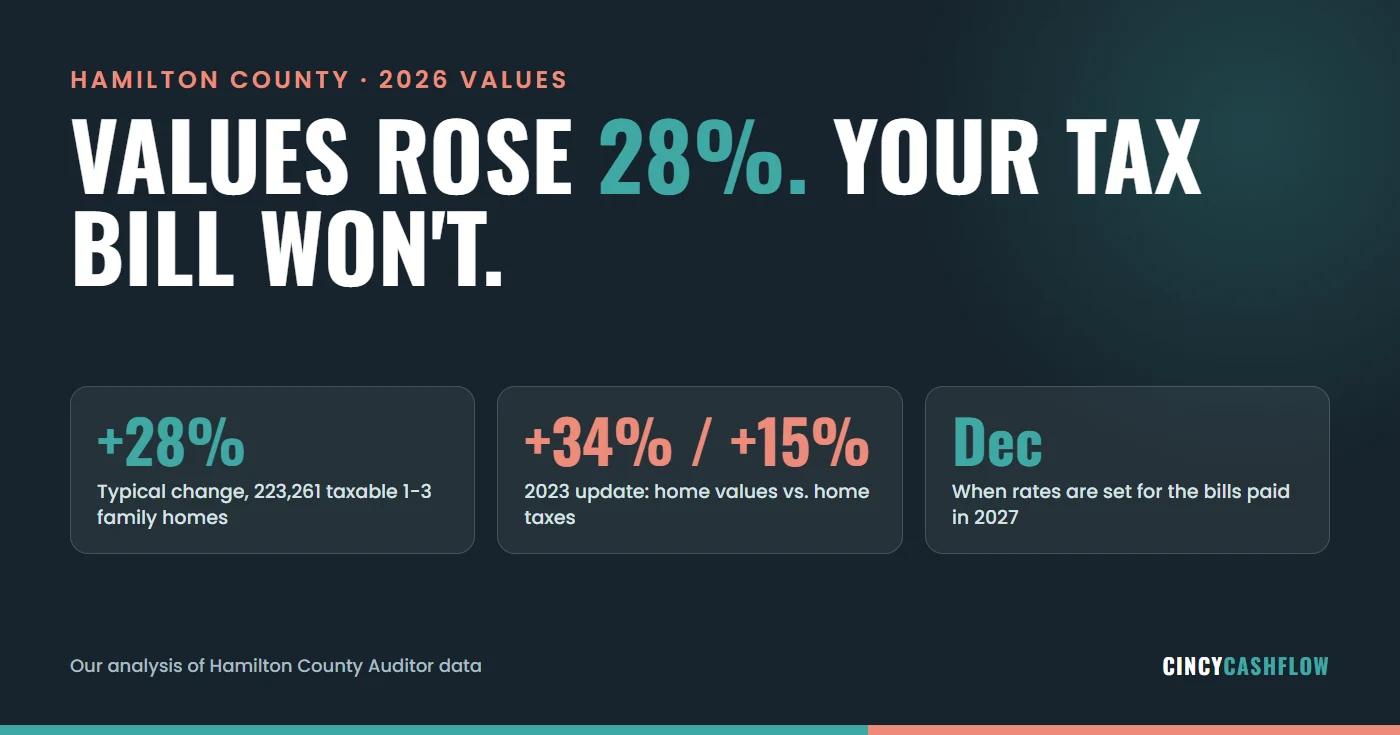
How much Hamilton County values rose
- Six in ten homes rose between 20% and 30%. The middle half rose 25% to 34%. A little over a quarter rose more than 30%, about one in ten rose less than 20%, and almost none went down.
- The city of Cincinnati came in at +30% across 65,131 homes. The rest of the county came in at +28%.
- All taxable property rose about 23%, from $101.0 billion to $123.9 billion of market value. Commercial property rose about 15%.
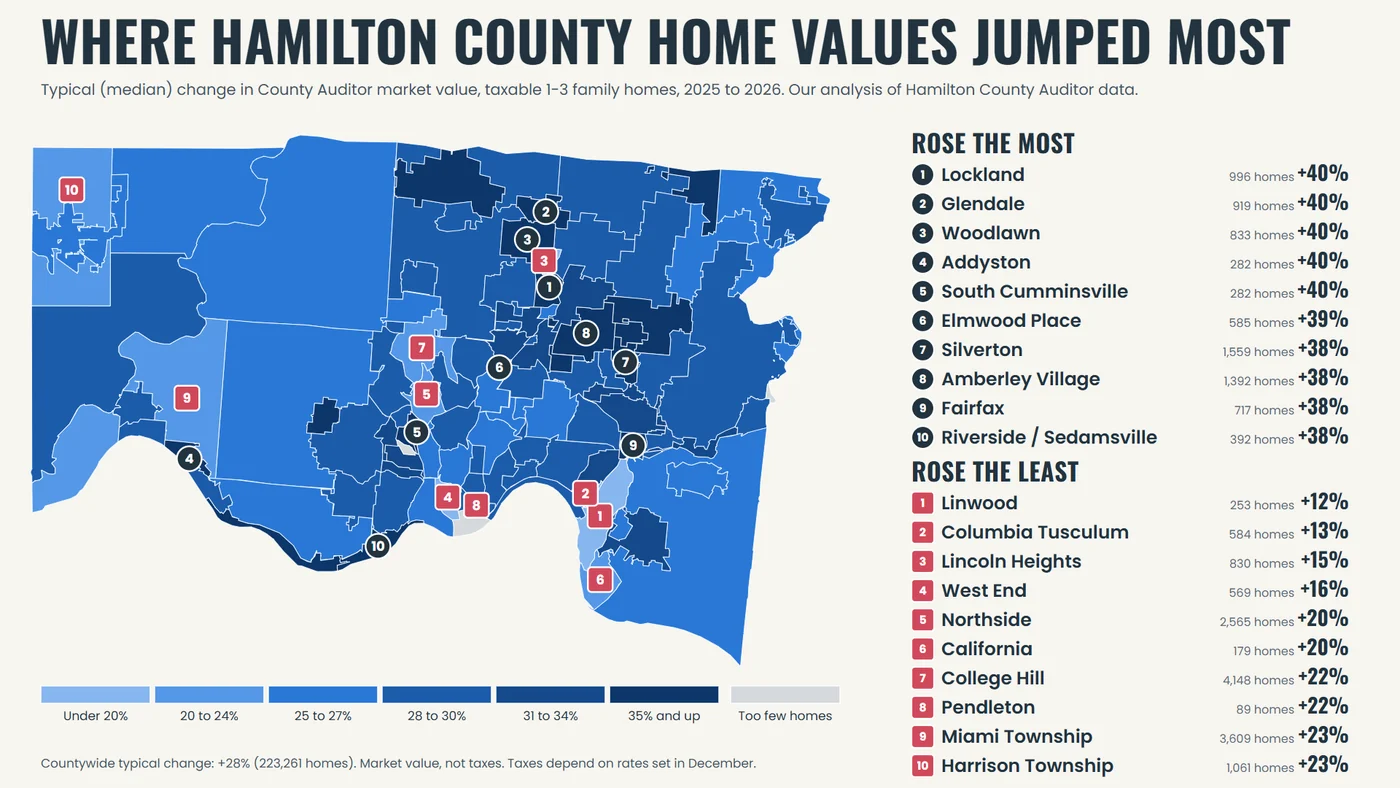
The biggest jumps, around 40%, came in Lockland, Glendale, Woodlawn, Addyston and South Cumminsville. Elmwood Place, Silverton, Amberley Village and Fairfax followed in the high 30s.
The smallest increases came in Linwood (+12%) and Columbia Tusculum (+13%), then Lincoln Heights and the West End in the mid-teens. Northside came in around 20% and College Hill around 22%.
Glendale and Amberley Village sit near the top next to Lockland and Elmwood Place. The pattern tracks which neighborhoods traded. Price tier and side of town don't explain it.
Value change by school district
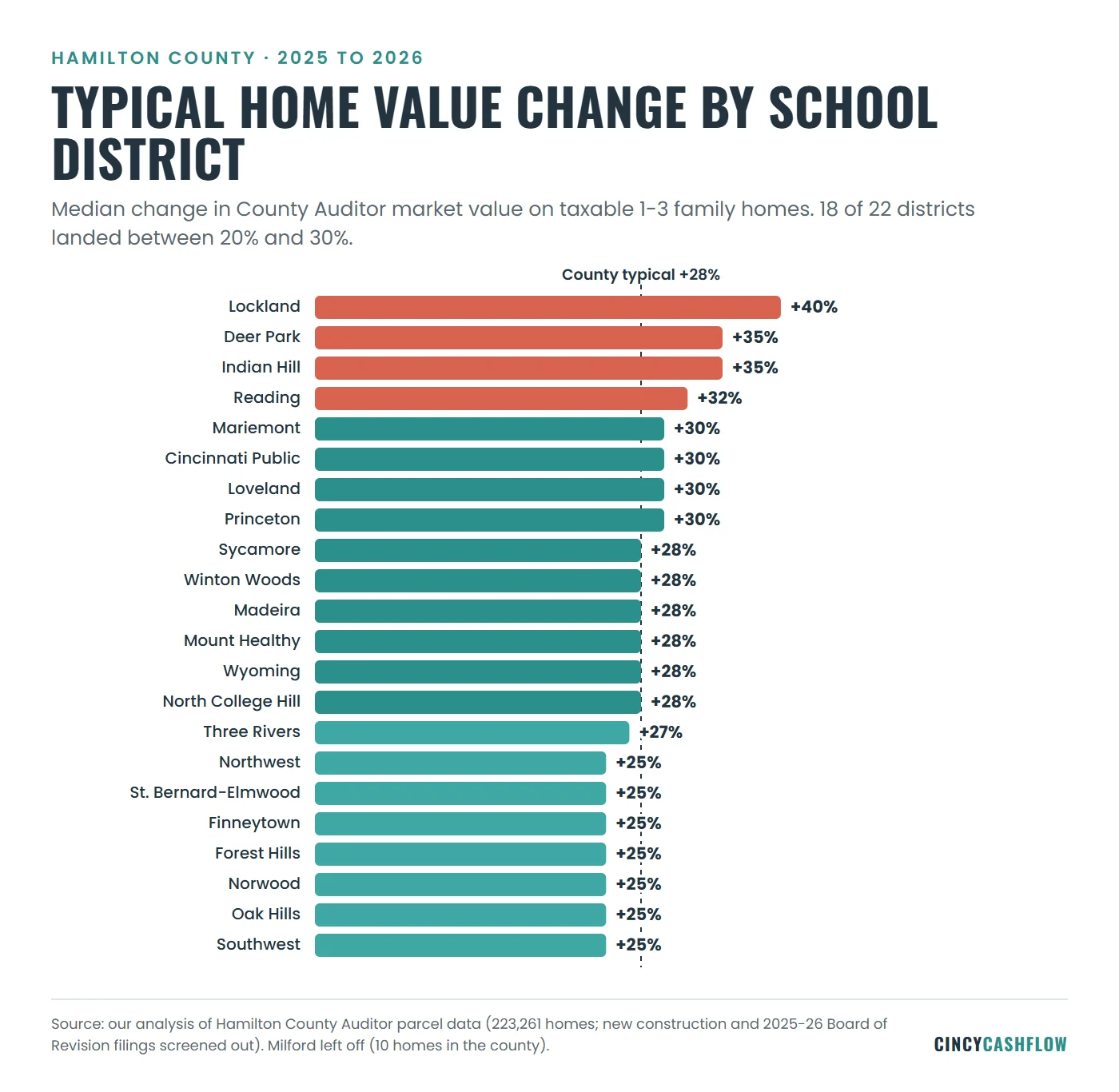
Eighteen of the county's 22 school districts landed between 20% and 30%. Lockland was highest at +40%, followed by Deer Park and Indian Hill at +35% and Reading at +32%. Cincinnati Public came in at +30%.
Oak Hills, Southwest, Northwest, Forest Hills, Finneytown, Norwood and St. Bernard-Elmwood all came in at +25%.
How the county set the new values
This was a three-year update, not a walk-through of every house. The Auditor calls it a desktop, statistical review of more than 350,000 parcels.
- Your neighborhood's number became your number. 93% of homes that didn't sell got their neighborhood's exact percentage, across 945 appraisal areas.
- A 2025 purchase reset your value. 88% of the 8,267 homes that sold in 2025 are now valued within 1% of the sale price.
- 2026 sales mostly were not reset, because values are set as of January 1. Only 24% of January-June 2026 sales and 3% of July-October sales came in at price.
The last full reappraisal, with a look at every property, was 2023. The next one is 2030.
What you own changed your number
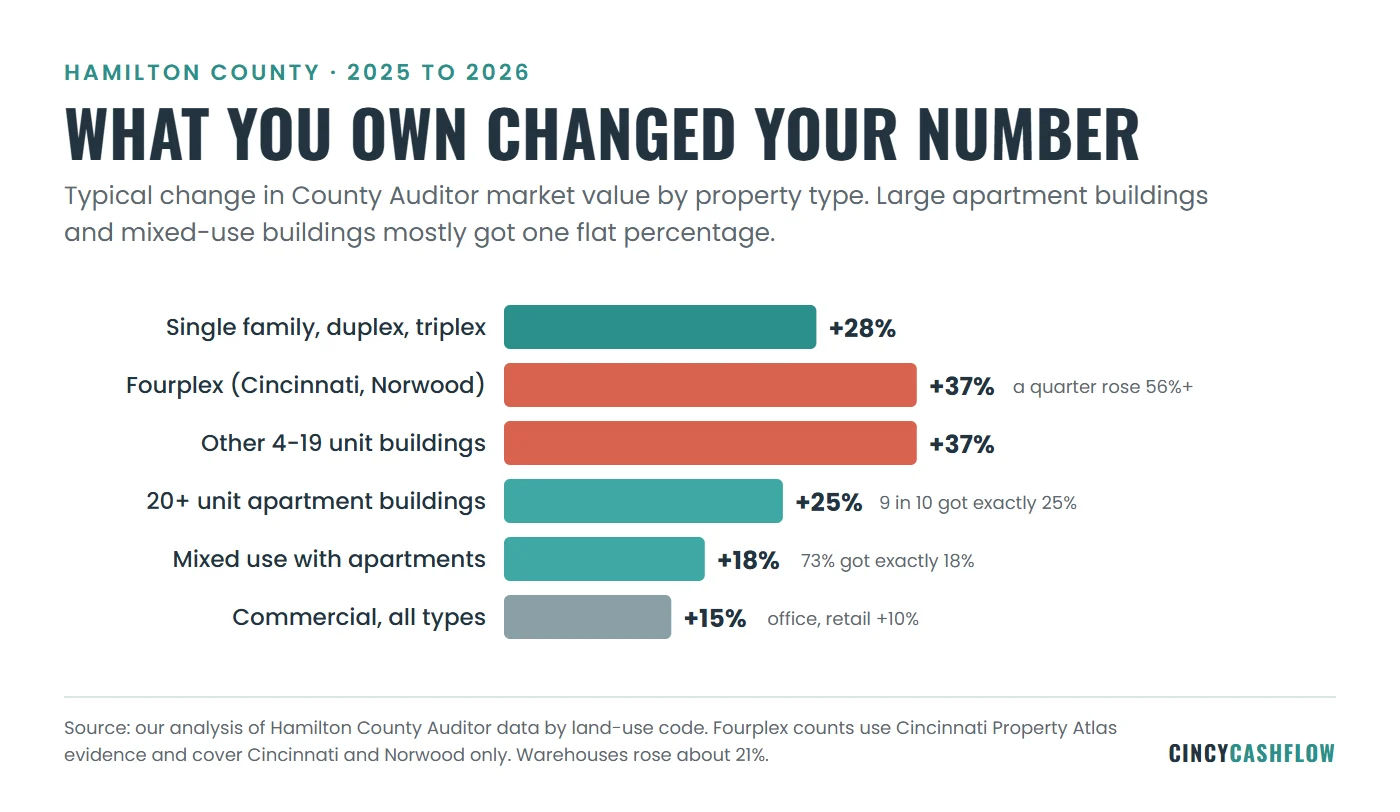
Single-family homes, duplexes and triplexes all came in around 28%. Fourplexes in Cincinnati and Norwood rose 37%, and a quarter of them rose 56% or more. Other 4-19 unit buildings also rose 37%.
Apartment buildings with 20 or more units mostly got a flat 25%. Buildings with apartments over storefronts mostly got a flat 18%. Offices and retail rose about 10%, and warehouses about 21%.
If you own small multifamily in the city, check your parcel. The county followed sales, and fourplexes have been trading up.
Why a 28% value jump is not a 28% tax jump
When values rise, Ohio law shrinks the rate on voted levies so they bring in about the same dollars. The last time values jumped, in 2023, Hamilton County home values rose 34% and home taxes rose about 15%.
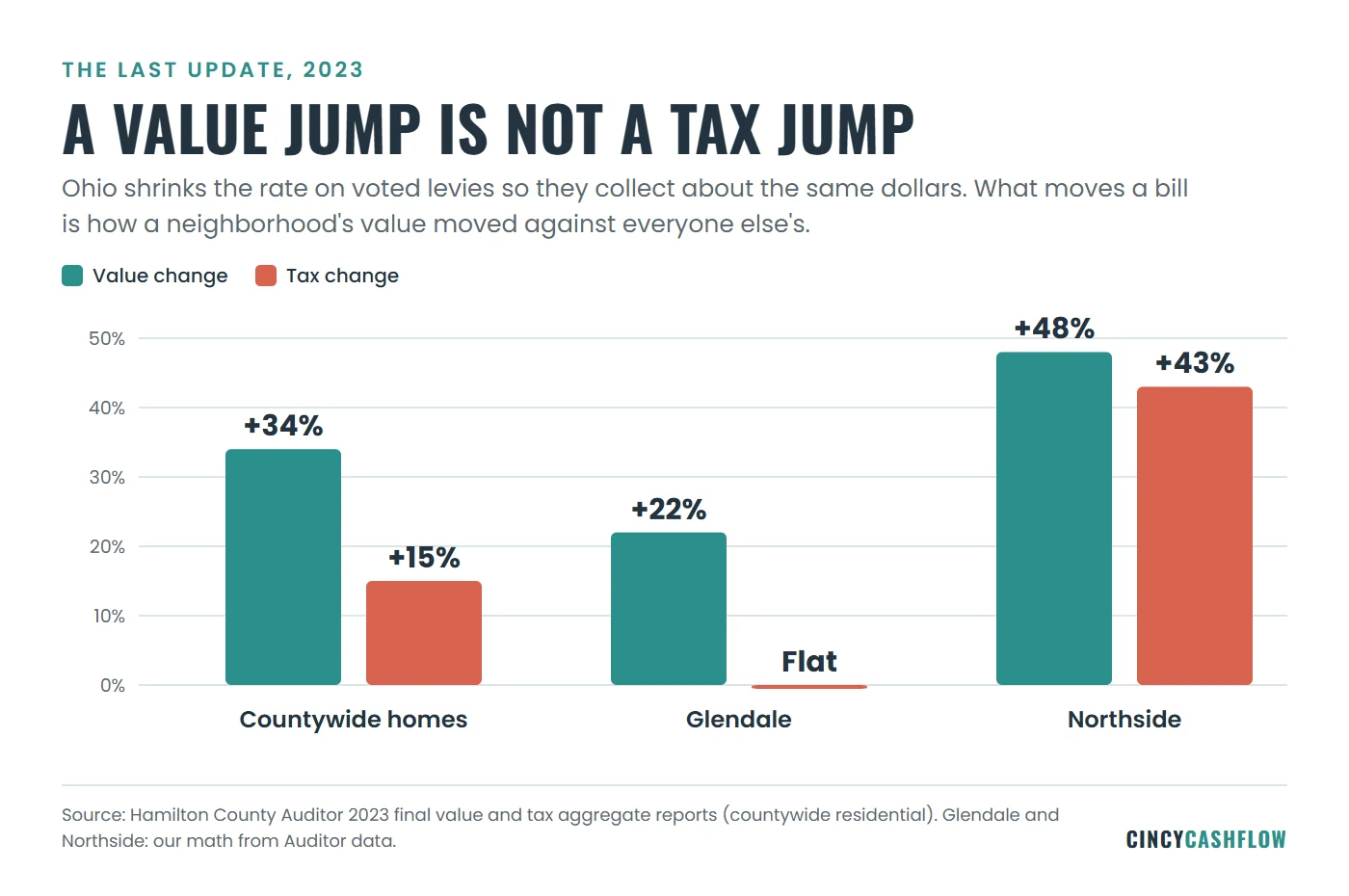
What moves an individual bill is how a property's value moved against everyone else's. In 2023, Glendale's values rose 22% and its taxes stayed flat. Northside's values rose 48% and its taxes rose 43%.
Three things are different this year:
- New levies stack on top. The CPS 7-mill levy and the Children's Services increase are collected at their full voted rates. See the November 3 results.
- Some millage still floats with value. Inside Cincinnati, the city's 6.10-mill charter levy is the one piece of a city bill that rises with value, and City Council sets it again in December.
- Rates are not set yet. They are certified in December, so nobody can give you an exact 2027 bill today.
Small rentals lose a credit
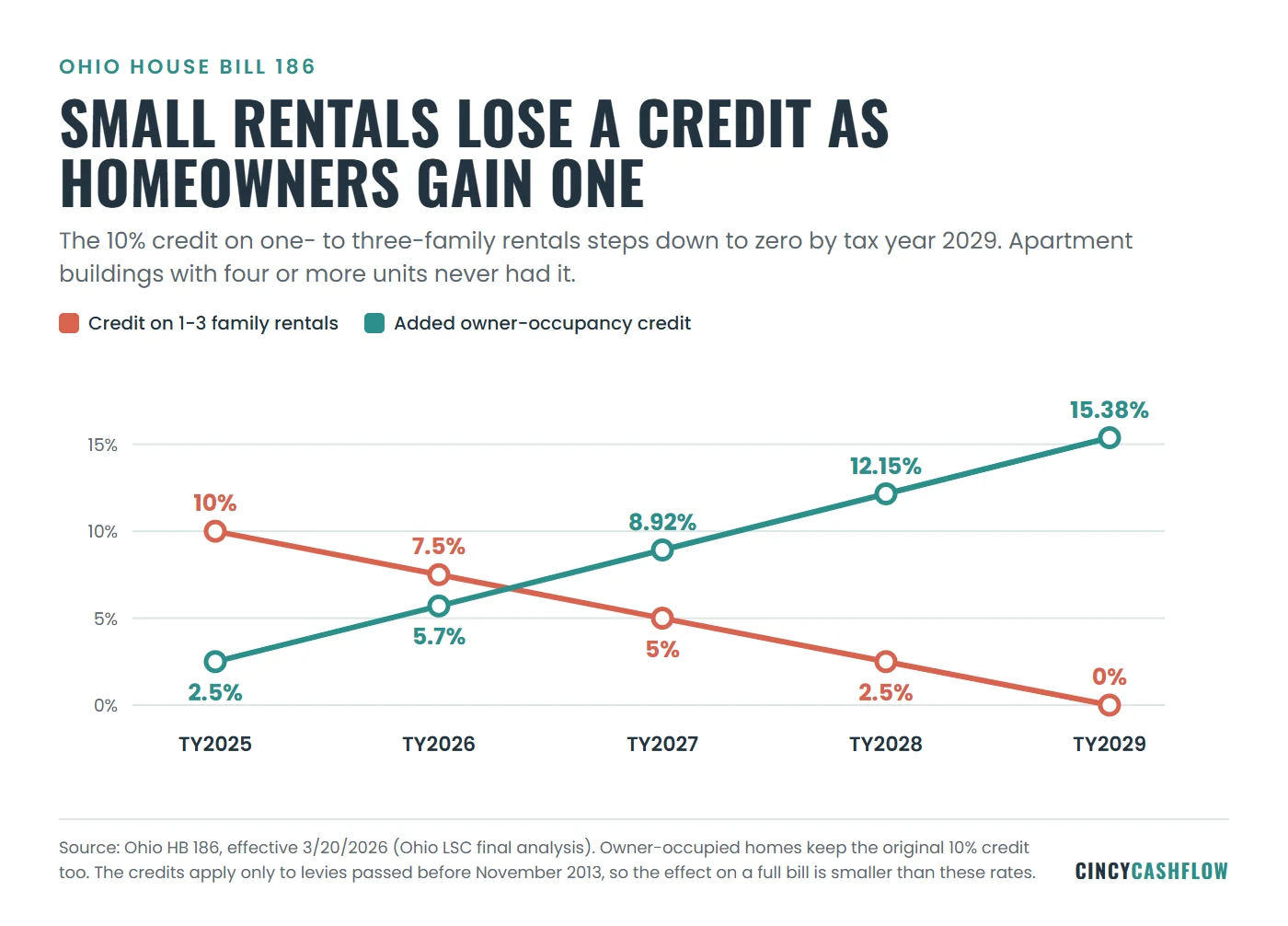
One- to three-family rentals face a second change. Under House Bill 186, the 10% credit they shared with homeowners steps down to 7.5% this tax year, then 5%, then 2.5%, and reaches zero in tax year 2029. Over the same years, owner-occupied homes gain an added credit that grows to 15.38%.
Apartment buildings with four or more units never had that credit, so they don't feel this part. The credits apply only to levies passed before November 2013, so the effect on a full bill is smaller than the headline rates.
For a small rental, copying last year's tax expense and adding a standard inflation percentage could miss a meaningful change. The building across the street may be a poor comparison if its tax treatment differs from yours.
How to budget 2027 property taxes on a rental
- Look up the 2026 value on the Auditor's triennial page at hcauditor.org/triennial.asp. Include the .asp. The main property search keeps showing the 2025 value until December.
- Identify the taxing district and any new levies on it.
- Check the property's class and credits. Owner-occupied, one- to three-family rental and four-plus units are each treated differently.
- Hold a range until December. Build the final number once rates are certified.
- If you are buying, ask for the actual parcel information and build the tax expense from there. A countywide headline cannot tell you the bill for a specific address.
The new taxes do not arrive as a separate bill to renters. Owners may try to recover higher costs through rent, subject to lease terms and what the market supports. A resident still has to decide whether the home fits their budget, so occupancy, renewals and the competing rentals nearby belong in that conversation alongside the tax bill.
Should you appeal your value?
The Hamilton County Board of Revision window runs January 1 through March 31, 2027, by USPS postmark. The Board's own page still shows last cycle's dates, so use these.
- The Board can raise a value as well as lower it (ORC 5715.11).
- School boards can file their own counter-complaint (ORC 5715.19).
- One complaint covers the whole 2026-2028 cycle, unless there is a new sale, a casualty or a major improvement.
- You can file for your own property without a lawyer, and hearings run about 15 minutes.
If you paid more than the new value, think twice before you file. If you have real evidence below the county's number, such as a recent appraisal or purchase, compare it with the property's condition before deciding.
Featured in the Cincy Cash Flow Report, Issue 21. Value figures are our analysis of Hamilton County Auditor data pulled November 9-10, 2026.
Keep reading
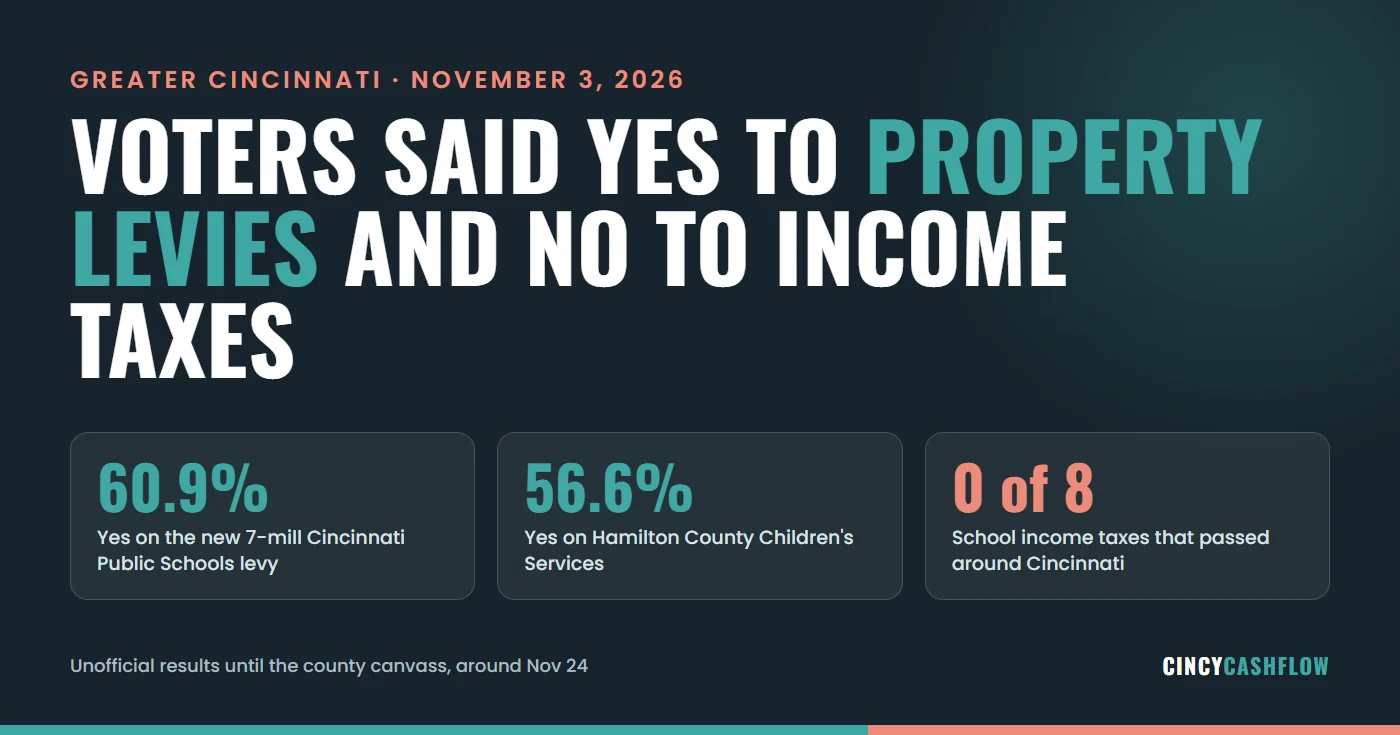
Greater Cincinnati Election Results 2026: Property Levies Passed, School Income Taxes Failed
CPS's 7-mill levy and Children's Services passed, every school income tax failed and Akron passed tenant rules. What the Nov. 3 results mean for owners.
5 min readRead →

School Districts and Single-Family Rentals: The Variable Most Investors Misread
Assigned schools shape price, tenant tenure and exit demand. How to match a school district profile to a cash flow or appreciation strategy before you buy.
4 min readRead →

Multifamily Insurance Costs: How to Underwrite Around Rising Premiums
Per-door insurance premiums jumped over the past 12 to 24 months. Stress-test renewals so a $300 per unit miss does not cost you $30,000 of NOI.
1 min readRead →