Ohio After the 2026 Election: What Landlords Should Watch in Columbus and Akron
The statewide results matter to Cincinnati owners mostly for what they make easier or harder in Columbus. Property tax relief, school funding and landlord-tenant rules all run through the next budget and the next General Assembly. None of the proposals below is law, and the results stay unofficial until the canvass.
Who controls what after November 3
| Office | Result (unofficial) | What it means |
|---|---|---|
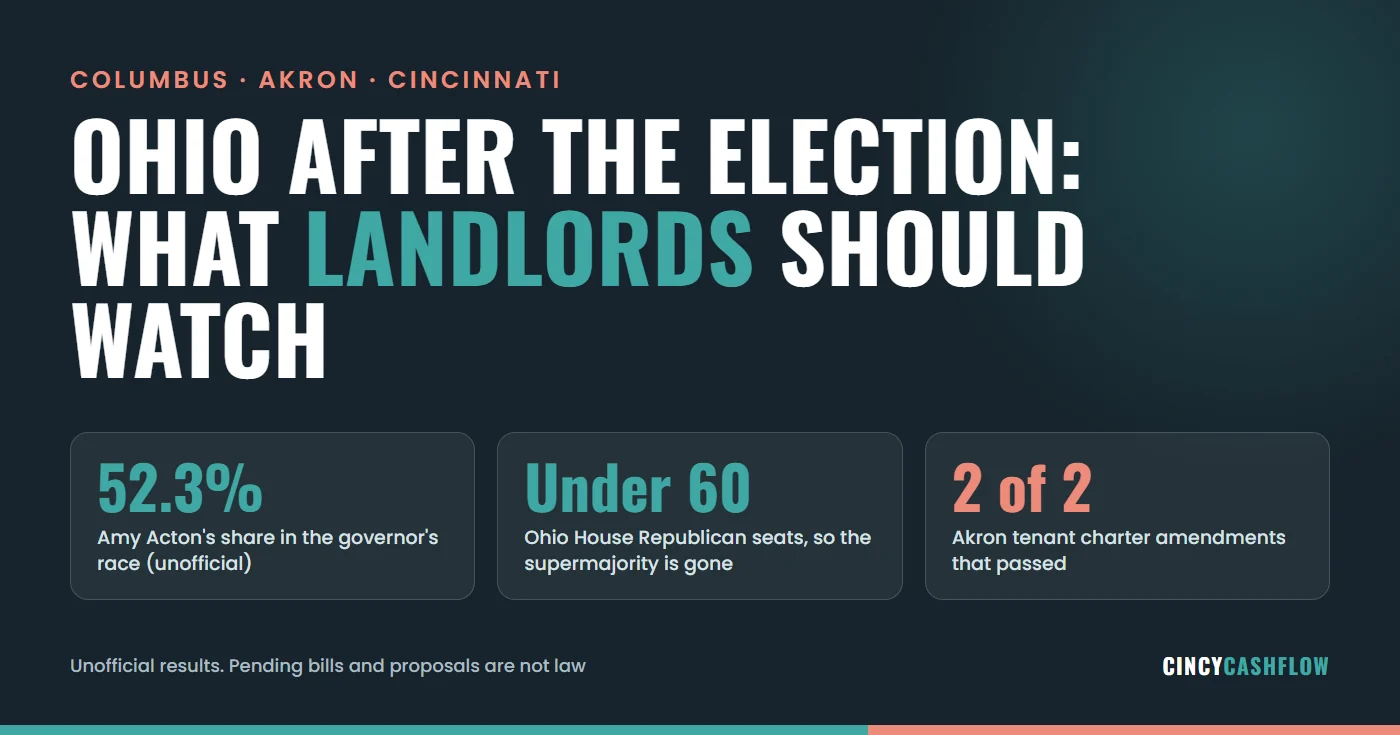
| Ohio governor | Amy Acton (D), 52.3% to 44.4% | Takes office in January. Her first budget is due by March 15, 2027 |
| Ohio House | Republicans 52-53, Democrats 42, a few uncalled | Below the 60 seats for a supermajority, so vetoes need some Democratic votes to override |
| Ohio Senate | Republicans 22, Democrats 11 | Supermajority holds |
| Statewide row offices | Attorney general, secretary of state and treasurer flipped to Democrats. Auditor stayed Republican | |
| U.S. Senate (Ohio) | Sherrod Brown (D) over Jon Husted (R), 50.0% to 45.2% |
In Columbus, property tax and school funding changes now need both parties. A veto override takes three-fifths of each chamber.
What Acton has proposed on property taxes and housing
| Topic | What she has said | How concrete |
|---|---|---|
| Senior homestead exemption | Raise the household income cap to $50,000, from about $41,000 | A number, no cost or funding source |
| Property tax rebate | Up to $1,000 when a homeowner's bill rises more than 4% in a year, for households under $132,000 in homes worth $350,000 or less | Thresholds, no funding source or process |
| Tax-lien sales | Crack down on private tax-lien certificate sales | Direction only |
| Housing supply | Expand Welcome Home Ohio toward new construction, including workforce apartments; a governor's housing council; faster permitting; first-time buyer support | Goals, no dollars or timeline |
| Corporate home buying | Limit "the ability of corporations to buy up housing" | No mechanism, threshold or bill |
| Property tax abolition | Called it "reckless" | Opposed |
| School funding | Fully implement the Fair School Funding Plan | A pledge, no cost or source |
Her relief plan is aimed at homeowners. We found nothing on renters, landlords, rent rules or the rental credit that is phasing out under House Bill 186.
The one item that could touch investors, a limit on corporate home buying, has no definition yet. Watch for who it covers: LLCs, portfolio size, or only large institutional buyers. Until a bill or a budget line exists, keep proposed relief out of the base budget.
Landlord-tenant bills still pending in Columbus
| Bill | What it would do | Status |
|---|---|---|
| House Bill 553 | A landlord would give notice of a rent default within 60 days. If not, no eviction filing until notice, a payment plan offer and a 90-day wait | In House committee |
| House Bill 368 | Automatic sealing of eviction records after three years | In House committee |
| House Bill 92 | Ends municipal liens on landlords for tenants' unpaid water and sewer bills, and limits shut-offs | Passed the House in March 2026, waiting in the Senate |
These are proposals, not requirements. The 136th General Assembly ends in December, and bills that don't pass by then have to be reintroduced. HB 92 is the one that has moved.
Akron's tenant measures
Akron voters passed two charter amendments aimed at rental housing.
- Issue 11 (57.8% yes) bans rental application and pre-lease fees, lets tenants pay a security deposit over three or six months, and carries criminal penalties.
- Issue 12 (50.9% yes, a 999-vote margin) makes criminal history a protected class in housing, with exceptions for sex and arson offenses.
Opponents say they will sue, and a 2022 Ohio law (R.C. 5321.19) limits what cities can regulate in this area. No court has ruled. Nothing like this was on Cincinnati's ballot.
I would follow how Akron implements these, and how the challenges go, before drawing conclusions about rules here. A tenant group won two ballot issues in one night, and that playbook can travel.
Closer to home
- Two Cincinnati City Council seats open in January. Seth Walsh won state treasurer, 50.55% to 49.45% in unofficial returns, and Meeka Owens won a Hamilton County commission seat. How the seats get filled has not been announced.
- A West Side Ohio House race is inside recount range. In District 29, Rep. Cindy Abrams (R-Harrison) leads Democrat Jonathan Bradner by 19 votes, within Ohio's automatic recount margin. A recount can only start after the canvass is certified.
- The property tax abolition amendment missed 2026. It fell short of the 413,488 valid signatures it needed, and backers are aiming for the November 2, 2027 ballot.
What to do with this
- Budget on current law. HB 186's rental credit phase-out is law. Rebates, caps and abolition are not.
- Track the March 15 budget. That is where property tax relief and school funding get real numbers.
- Watch HB 92 in the Senate if you own in a city that liens landlords for tenants' water bills.
- Read Akron's rules as a signal, not a requirement, until courts weigh in.
For the local measures and what they cost per $100,000 of value, read the Greater Cincinnati election results.
Featured in the Cincy Cash Flow Report, Issue 21. Election results are unofficial until each county canvass, expected around November 24, 2026.
Keep reading
Greater Cincinnati Election Results 2026: Property Levies Passed, School Income Taxes Failed
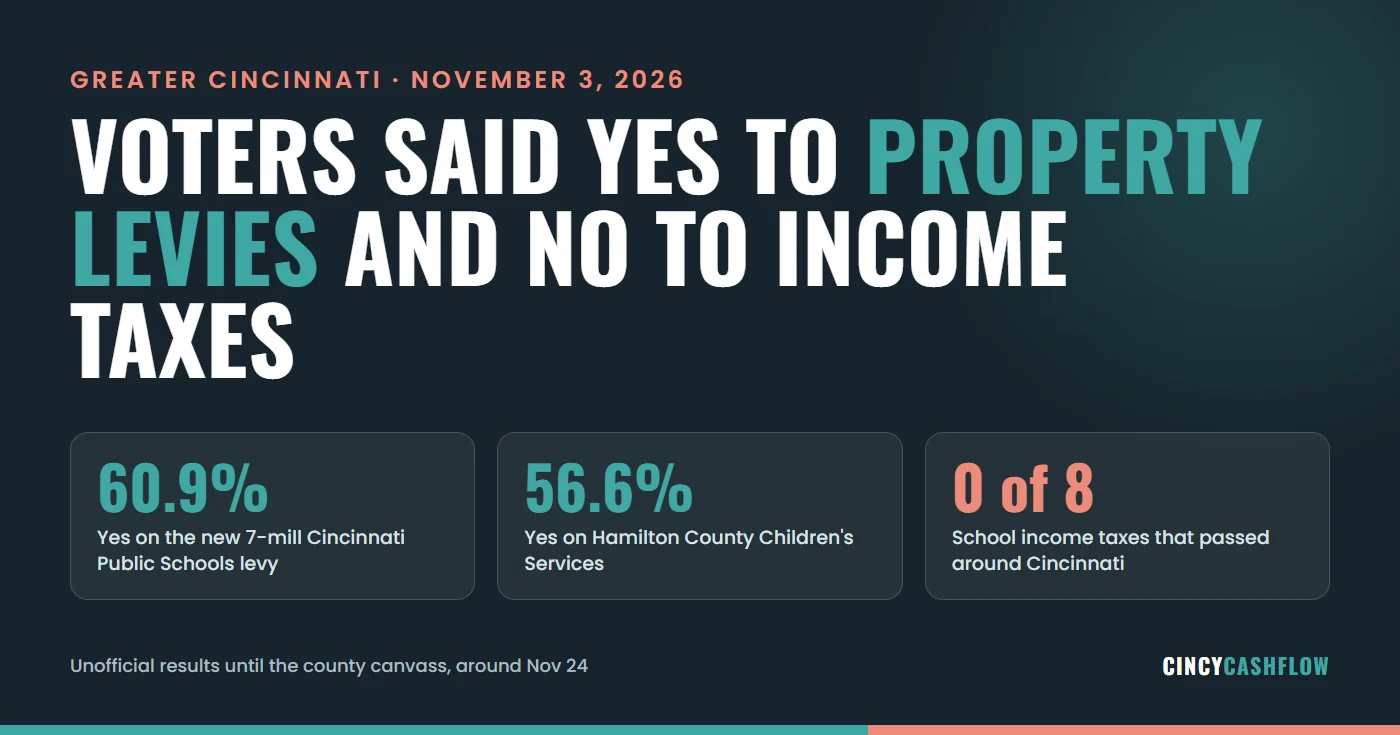
CPS's 7-mill levy and Children's Services passed, every school income tax failed and Akron passed tenant rules. What the Nov. 3 results mean for owners.
5 min readRead →

The ROAD to Housing Act: What the Institutional Investor Restriction Actually Says
Headlines call it a ban on big investors buying homes. The 350-home threshold, the exemptions and the build-to-rent carve-out show what the statute does.
5 min readRead →

How to Handle Evictions With Compassion: Lessons From TLP Property Management
TLP Property Management's operations director on communicating before rent is late, documenting in writing and treating tenants with dignity. Episode 17.
2 min readRead →