The ROAD to Housing Act: What the Institutional Investor Restriction Actually Says
Washington just cleared the most significant federal housing legislation in decades. The headlines call it a ban on big investors buying single-family homes. The statute reads more like a rulebook than a wall, and understanding that difference separates investors who react to a headline from those who read the market.

Status as of July 7, 2026, the date of the original issue. Check current status before acting on any provision.
The narrative behind the bill
For most of the last five years, one storyline has dominated the national housing debate: large investors are buying up America's single-family homes and pricing ordinary families out of the market. It has driven state legislation, local ballot measures, and a sustained push for Washington to step in. The 21st Century ROAD to Housing Act is the federal answer.
The narrative is louder than the data behind it. Institutional investors own well under 1% of the nation's housing stock. The deeper problem is supply: the country is millions of homes short of what its population needs and has been for more than a decade. When housing is scarce and demand holds steady, prices rise, and the search for a single cause settles on the most visible target.
The arithmetic points to something less satisfying. We do not build enough. That tension runs through the entire bill. One section restricts large investors. More than 40 others are written to build.
Who the restriction targets
The provision drawing attention prohibits what the law calls a "large institutional investor" from acquiring additional single-family homes. The definition is the whole story. A large institutional investor is a for-profit entity that controls 350 or more single-family homes, directly or indirectly.
That threshold is deliberately high. It is written for the institutional funds that hold tens of thousands of houses nationwide. It does not describe the local owner with a dozen rentals, and it does not describe the large majority of investors and syndicators working a regional market. For most owners, the practical effect of the so-called ban is that it governs someone else's business.
A rulebook with a path through it
Even for the institutions above the threshold, the prohibition is far from absolute. It comes paired with a defined set of exemptions, and the cleanest path through it is simple. A large investor can keep acquiring existing homes by doing two things, both of which any good operator can adopt:
- Report tenant rent payments to the credit bureaus, so renters build credit for paying on time.
- Give the tenant the first opportunity to buy the home before it is listed or sold to anyone else.
The law also leaves room for homes acquired in poor condition and substantially renovated, which preserves the value-add model that brings aging housing back into service.

Build-to-rent survived
An earlier version of the bill was considerably more restrictive. It would have forced build-to-rent operators to sell off homes on a fixed timeline, a requirement that froze an estimated 10,000 build-to-rent units in the development pipeline this year while capital waited for clarity.
The final bill removes the forced-sale requirement and carves out build-to-rent communities, letting operators build and trade among themselves. For the construction side of the market, this provision restores the certainty capital needs to move, which is the purpose of a supply bill.
The burdens to watch
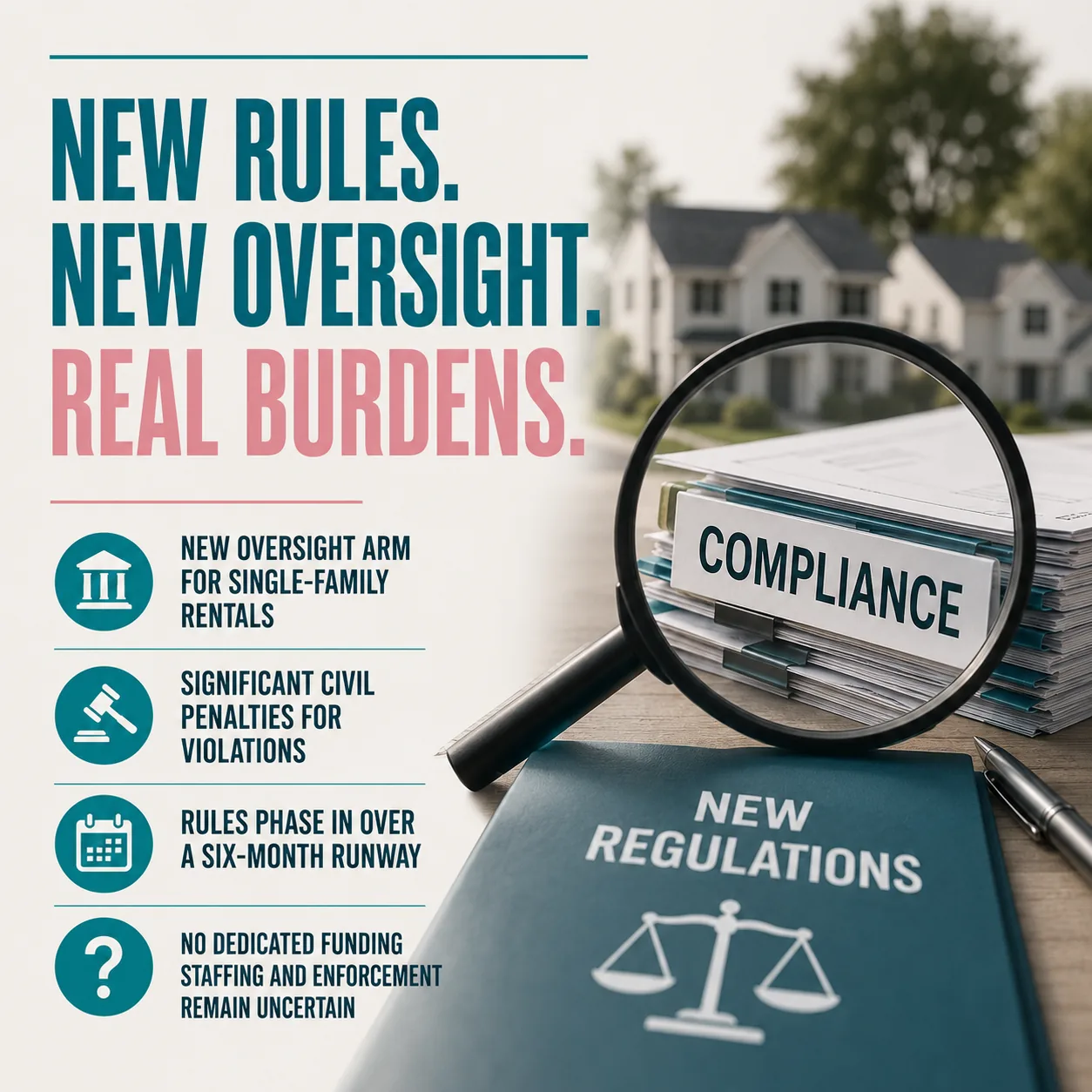
The new regime brings friction. The law stands up a substantial new oversight function over the single-family rental market, carries significant civil penalties for violations, and phases in over a runway of roughly six months before the rules take effect.
That oversight arm arrives without dedicated funding attached, so how it is staffed, defined, and enforced is the open question that will shape the law's real impact over the coming year. The headline risk is small for most investors. The compliance and reporting burden for the largest owners is real.
It was not law yet
Congress passed the bill with wide bipartisan margins: 85 to 5 in the Senate and 358 to 32 in the House. As of the original issue, the President had not signed it. He had paused his signature, tying it to a separate voter-identification measure still moving through Congress. Under the Constitution, if he neither signs nor vetoes a bill within ten days while Congress remains in session, it becomes law on its own.
Until that resolves, the rules described here are coming but are not yet in force.

What it means for residential investors
For an investor operating at a regional scale, the right response is measured. Owners of single-family rentals sit well below the 350-home line, and their strategy is unaffected. The practices the law would eventually require, reporting rent to the bureaus and offering tenants a first look, are good business on their own terms and worth adopting now.
The larger signal is encouraging. A bipartisan, supply-first posture out of Washington is the most constructive thing housing policy has produced in a generation. It favors new construction. It favors, just as much, the work of acquiring and repositioning the homes that already exist in cities that have not built nearly enough of them. That thesis did not change this month. It picked up a tailwind.
The discipline is the same as it ever was. Read the bill, not the headline, and then go to work.
General information for educational purposes. Not legal or investment advice.
For how policy pressure shapes portfolio buyers, read why we buy scattered-site single-family portfolios when others cannot.
Originally published in the Cincy Cash Flow Report on July 7, 2026.
Keep reading

Buying Scattered-Site Single-Family Portfolios When Others Can't
Why we buy scattered single-family portfolios at scale while much of the market moves the other way: fewer buyers, harder operations and a gap few firms fill.
2 min readRead →
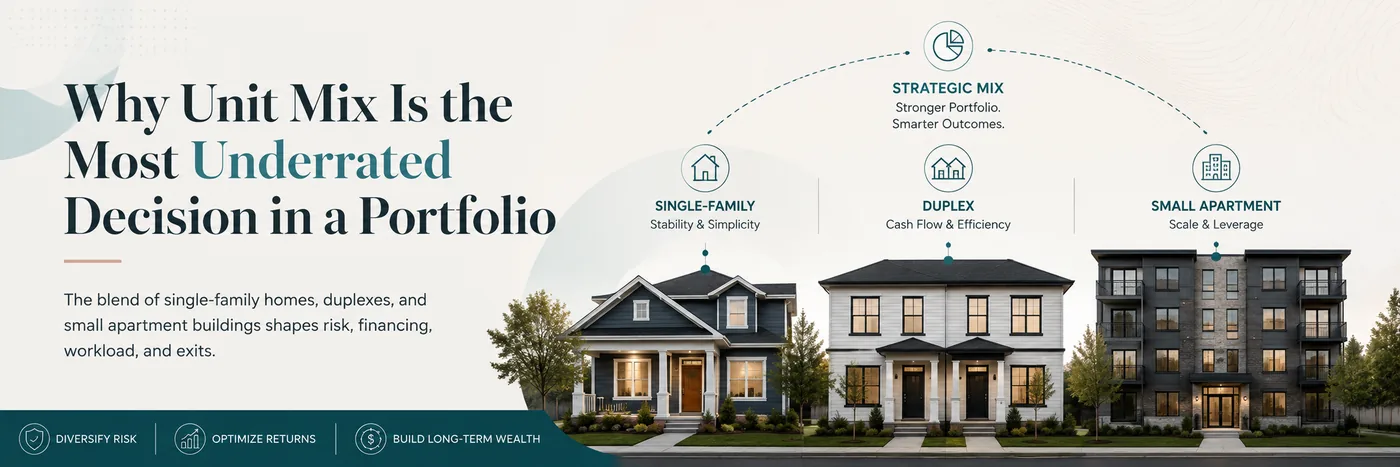
Unit Mix: The Most Underrated Decision in a Rental Portfolio
Single-family homes, duplexes and small apartments each do a different job. How unit mix sets your risk, financing, workload and exit.
3 min readRead →
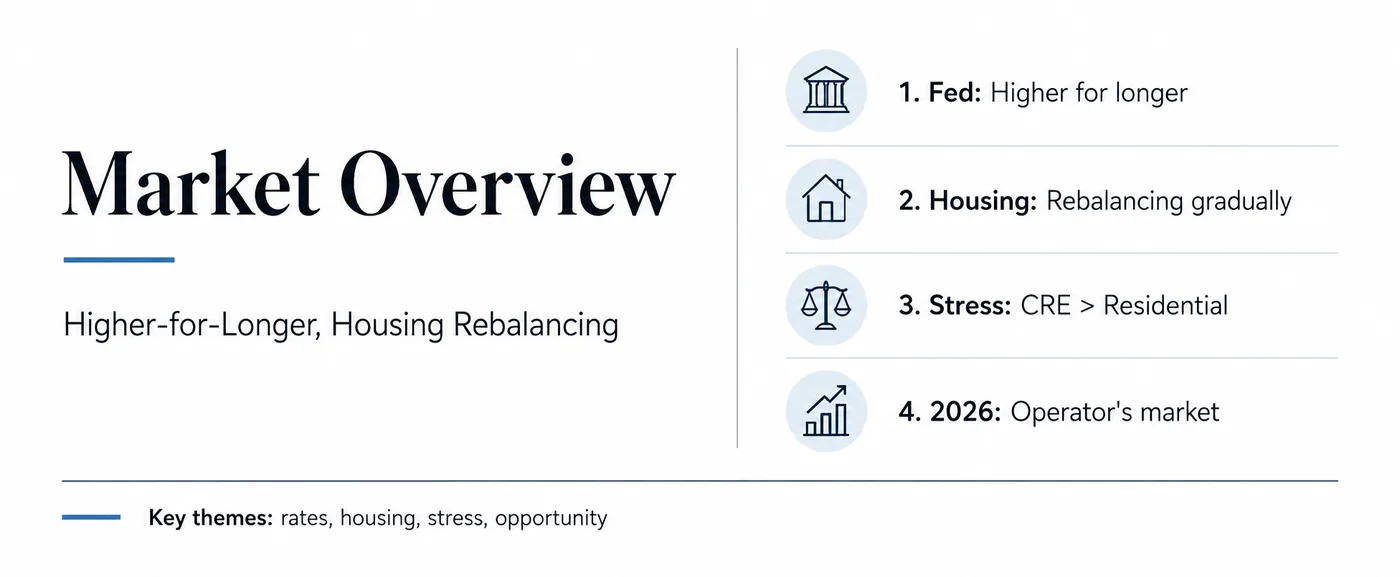
Higher for Longer: The Fed, Housing and Where Distress Is Showing Up
Rate relief is a possibility, not a plan. Where housing is rebalancing, where commercial real estate losses are realizing, and how operators should position.
2 min readRead →