Cincinnati Market Update, November 2026: Kroger Cuts, Steady Rents and Long Runways Uptown
Cincinnati's local stories deserve more attention than a quick headline scan. A corporate restructuring, two university buildings and an acquisition in Over-the-Rhine affect different parts of the city on very different timelines. For rental owners, the useful question is when each one reaches a specific block, and whose rent it touches.
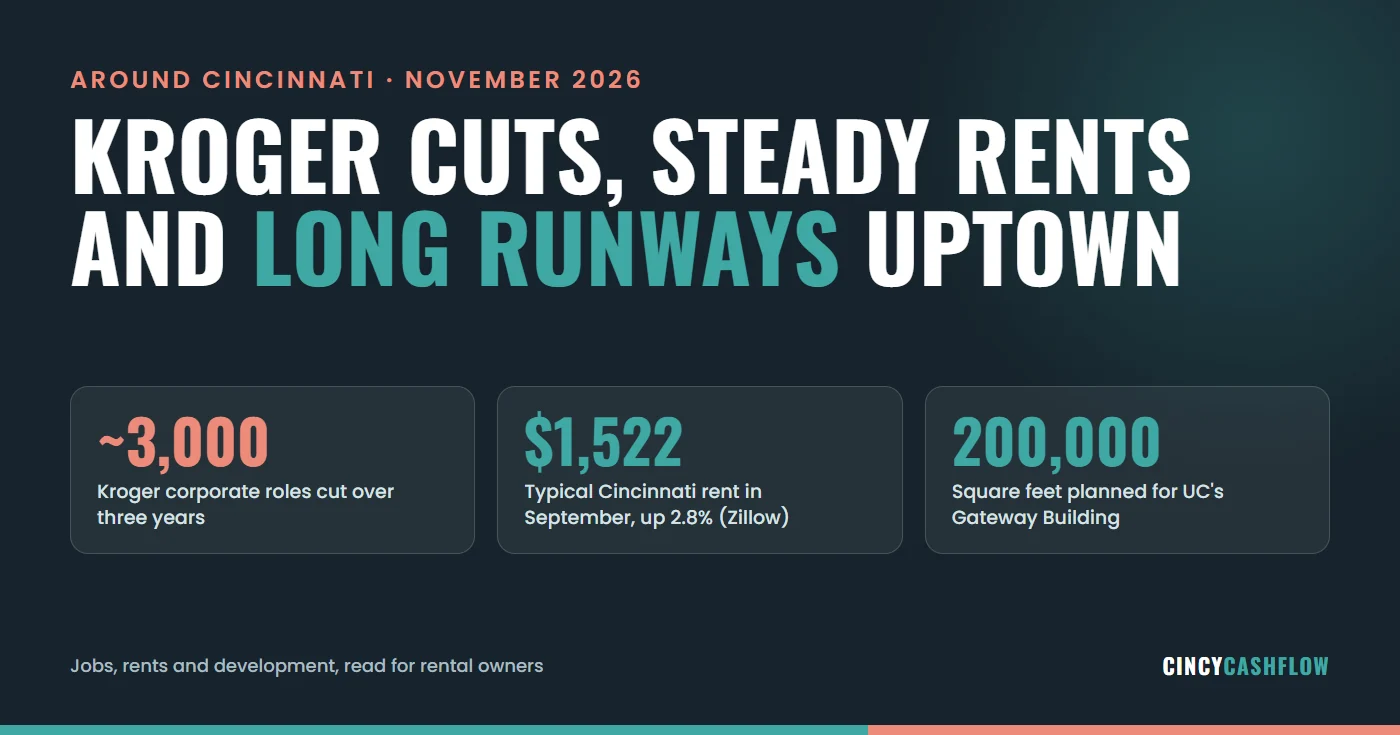
Kroger's restructuring: the local headcount is still unknown
At its October 20 investor day, Kroger said it will put $5 billion into lower prices through 2029, largely funded by about $4 billion in annualized cost savings. The plan cuts about 3,000 corporate roles over three years, roughly 37% of an 8,200-person corporate base, and moves some work to its capability center in India.
A Kroger spokesperson put the company's Greater Cincinnati office staff at about 4,800 in late 2025. Kroger has not given a Cincinnati-specific number, and we have not seen an Ohio WARN notice tied to the plan. Applying the local share of corporate staff to the total produces an estimate, and it would be premature to treat that estimate as a company announcement.
Procter & Gamble's restructuring, announced in June 2025, runs on a similar clock: up to 7,000 non-manufacturing roles worldwide over two years.
For rental owners, the useful questions are specific:
- Where will the reductions land? Downtown office demand and higher-income rentals near the core are the first places to watch.
- Over what period? A three-year plan reaches leasing gradually.
- How much does a property's resident base depend on those jobs? A building near Kroger's downtown headquarters carries different exposure than a fourplex in Westwood.
Ohio WARN filings and company disclosures will turn a broad announcement into something useful for local planning.
Rental demand: different measures tell different stories
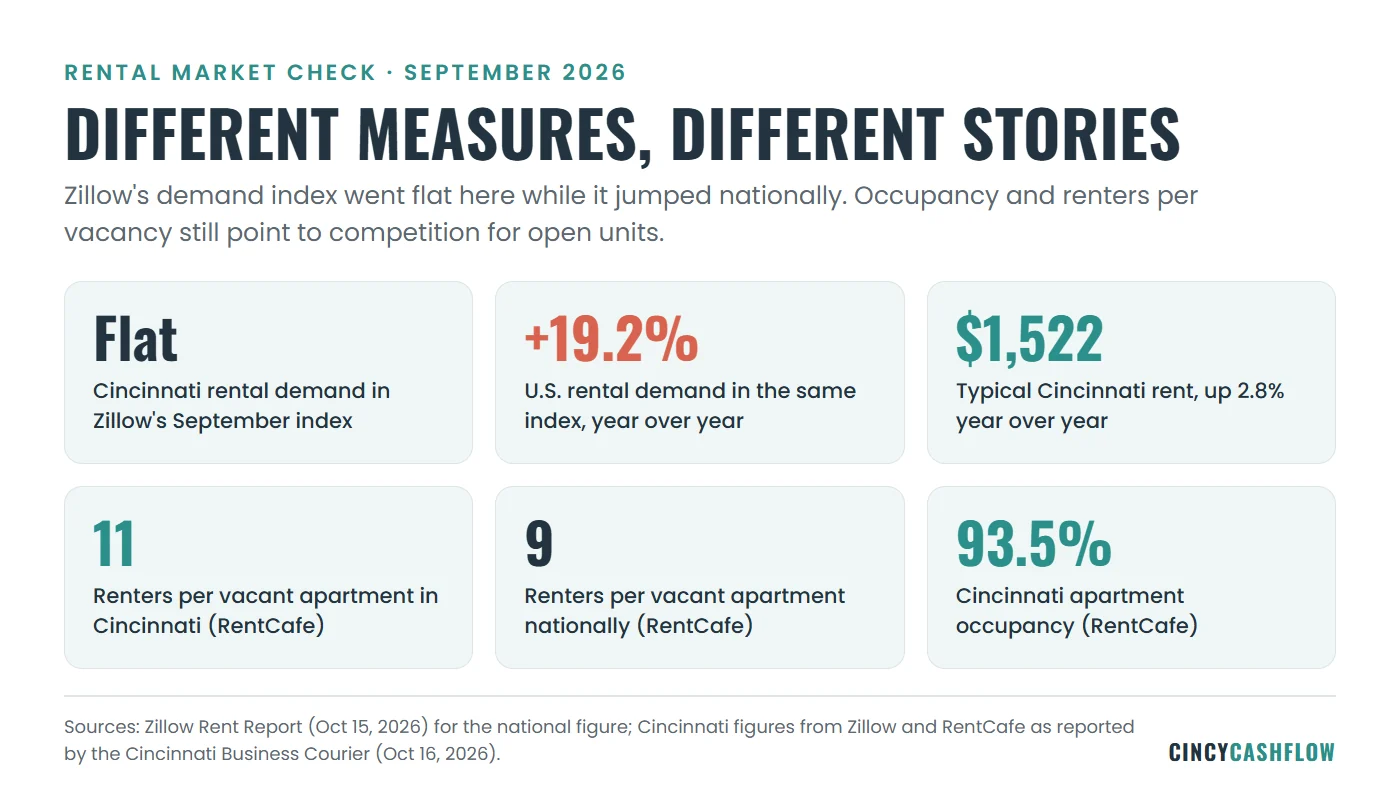
Zillow found Cincinnati rental demand flat in September while national demand rose 19.2%. Its typical Cincinnati rent was $1,522, up 2.8%. RentCafe reported 11 renters per vacant apartment here, against nine nationally, and 93.5% occupancy.
Those figures describe different parts of the market. Together they suggest continued competition for the apartments that are available, alongside limited growth in Zillow's demand measure.
For an individual property, I still start with the nearby alternatives. What can a resident rent for the same monthly payment? How does our unit compare on condition, location and convenience? How long are comparable listings sitting? A metro average provides context. The available apartment a prospective resident toured yesterday is more useful when setting the asking rent.
UC's next projects have a long runway
The University of Cincinnati's planned Gateway Building sits on the former College of Law site at Calhoun Street and Clifton Avenue. UC describes a 200,000-square-foot building with a welcome center, a 1,200-seat auditorium and a 400-space underground garage, designed by BIG. The Cincinnati Business Courier reported on November 4 that Skanska will build the $200 million project, with construction starting in February 2027 and an opening by July 2030.
A few blocks away, Skanska is taking down Crosley Tower piece by piece. UC plans a $304 million, 200,000-square-foot STEM academic building in its place.
For owners around Clifton, the schedule matters more than the headline. Construction traffic, street access and the finished buildings affect nearby rentals differently at each stage. I would track the project milestones while keeping near-term rent assumptions grounded in today's comparable properties.
3CDC's St. Francis Seraph purchase is an early step
3CDC is acquiring the former St. Francis Seraph church campus in northern Over-the-Rhine for about $5 million, with the city covering $4 million. The deal was first announced in July, and the Business Courier reported new details on November 3, including seven parcels on Liberty Street.
There is no redevelopment plan yet. Homeless services at the St. Anthony Center will stay until a new daytime care center opens elsewhere, and that location has not been chosen.
The purchase is worth tracking. The eventual use, the funding and the relocation will tell us much more about what it means for the surrounding blocks. I would be cautious about assigning a development premium to a nearby property before those pieces are in place.
Covington adds another startup exit
Yext completed its acquisition of Flamel.ai on November 2. The Business Courier describes Flamel as a five-person AI advertising company at Sparkhaus in Covington, the region's fifth startup exit this year, with plans to stay in Covington and hire.
Five people is a small employment base. The plan to stay gives us a concrete follow-up: whether that team grows locally after the acquisition.
What to do with this
- Map each story to your rent roll. Note which residents work downtown, uptown or in Northern Kentucky.
- Price units against today's alternatives, not the next headline.
- Track milestones, not announcements. WARN notices, groundbreakings and redevelopment plans are the dates that move rents.
For the rates and capital side of the market, read repricing without relief. For a Cincinnati operator's view on rents, read Venture's underwriting reset.
Featured in the Cincy Cash Flow Report, Issue 22.
Keep reading
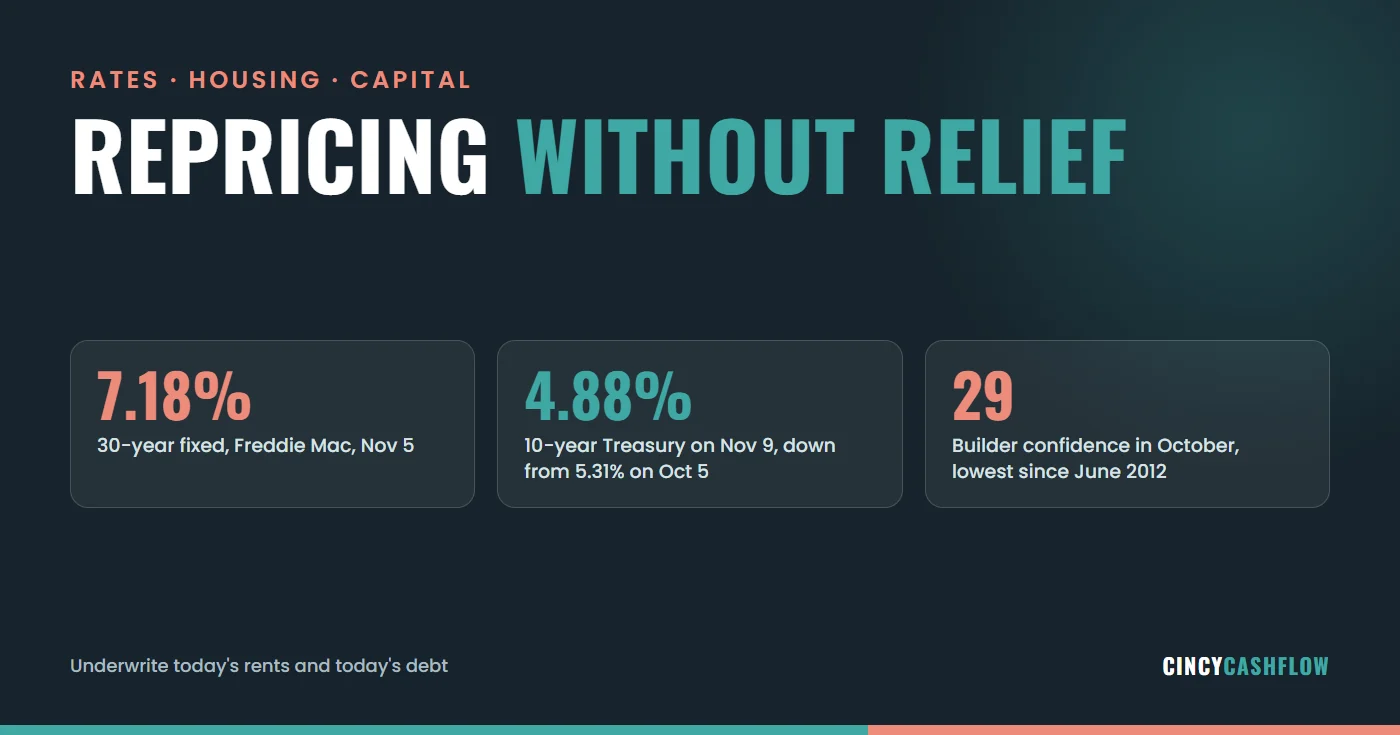
Repricing Without Relief: Mortgage Rates, Home Prices and Multifamily Debt in November 2026
The 30-year rate is 7.18% and the 10-year eased to 4.88%. Prices are up about 2%, builders are cutting prices and multifamily CMBS delinquency is 8.09%.
3 min readRead →

Cincinnati Rents in September 2026: Growth Slows and the 3-Bedroom Spread Hits 2x
Apartment rent growth fell to 1.1% year over year in Q2. Hamilton County's median ask is $1,500, and 3-bedroom rents run 2x apart inside one county.
3 min readRead →
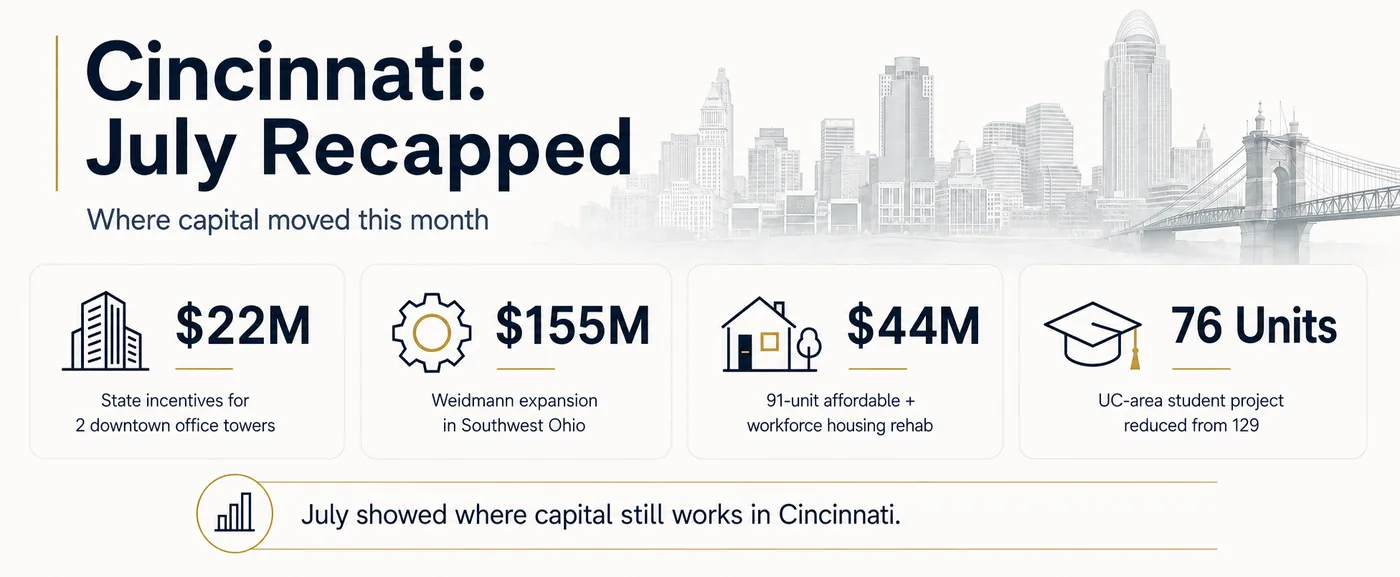
Cincinnati Market Update, July 2026: Flood Cleanup and Who Pays for the Fix
Record July rainfall, a sewer district short on cleanup funds, $22 million in office-tower incentives and a 129-unit project cut nearly in half.
2 min readRead →