Repricing Without Relief: Mortgage Rates, Home Prices and Multifamily Debt in November 2026
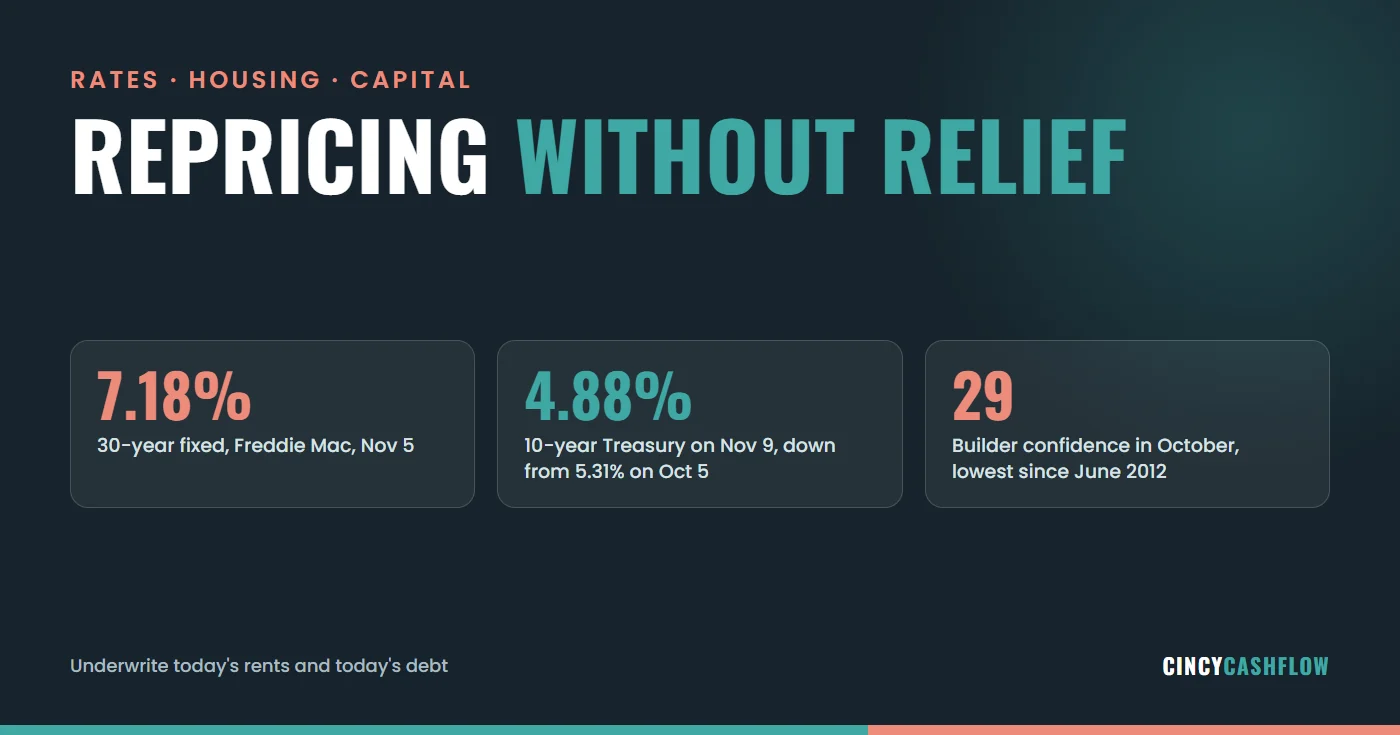
The Fed raised rates again in September and held in October, and its own projections don't show inflation back at 2% until 2029. Housing is adjusting to that. Capital is not getting cheaper on a schedule anyone can plan around, so the safest working assumption is that policy stays tight and any rate cut is upside.
Inflation is cooling slowly, and producer prices are not
- The Fed: a quarter-point hike on September 16 to 3.75%-4.00%, then a hold on October 28. Two members dissented in favor of another hike.
- The Fed's projections: PCE inflation of 3.7% in 2026, 2.3% in 2027, 2.1% in 2028 and 2.0% in 2029.
- Core PCE: 3.1% year over year in September, up from 3.0% in August.
- Producer prices: final-demand PPI rose 6.3% year over year in September, the largest 12-month increase since December 2022.
- Home prices: the Case-Shiller national index rose 2.1% year over year in August. With inflation running well above that, real home values are slipping.
Borrowing costs: Treasuries eased, mortgages barely moved
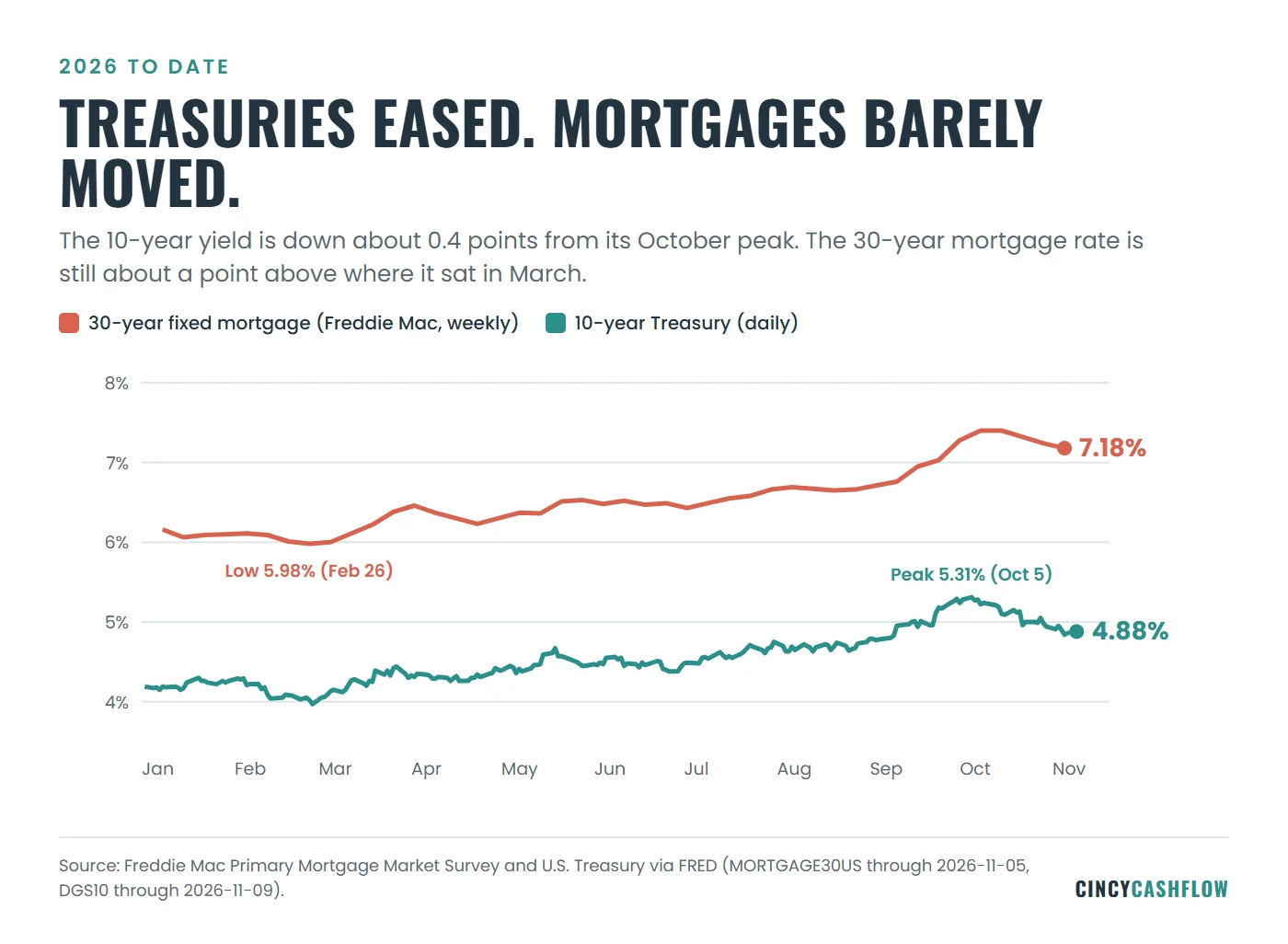
Freddie Mac's 30-year fixed rate was 7.18% on November 5, its third straight weekly decline from 7.40% in mid-October. That is still about a point above March, when it ran between 6.00% and 6.38%, and up from 6.22% a year ago.
The 10-year Treasury yield peaked at 5.31% on October 5 and was 4.88% on November 9. The inflation data hasn't improved enough to explain that move. Cheaper financing that comes from a weaker growth outlook is not an all-clear.
Sellers are adjusting
- Builders are cutting. The NAHB/Wells Fargo builder confidence index fell to 29 in October, its lowest since June 2012, and 43% of builders cut prices.
- Listings are cutting too. About one in five listings carried a price cut in September (Redfin 19.8%, Realtor.com 20.8%).
- Prices are holding nationally. Buyers are still out there. They are more selective and have more negotiating power, and conditions vary a lot from market to market.
Commercial real estate and multifamily debt
Trepp's multifamily CMBS delinquency rate reached 8.09% in October, up from 8.04% in September. The overall CMBS rate was 7.87%.
Cincinnati has been better insulated than many Sun Belt markets. Cap rates never compressed as far here, and fewer owners leaned on bridge and floating-rate debt, so in-place cash flow still covers debt service at refinance on more deals. That point came up on the Cincy REI Show with Robbie Hendricks of Venture Real Estate. Read his underwriting reset.
What to watch heading into 2027
This market rewards investors who have cash on hand and stick to their criteria, more than those waiting for rates to fall.
- Negotiate price, seller credits and repairs together.
- Underwrite on today's rents and today's debt costs. Treat a refinance as upside, not the plan.
- Know your loan maturities and how much floating-rate debt you carry.
- Watch the data calendar: Case-Shiller and FHFA for September on November 24, October PCE on November 25, and the December 8-9 Fed meeting with new projections.
- Watch whether lower Treasury yields actually bring mortgage rates down, and how lenders handle rising multifamily distress.
For what is happening locally, read the November 2026 Cincinnati market update.
Featured in the Cincy Cash Flow Report, Issue 22. Rates and data as of November 9, 2026.
Keep reading
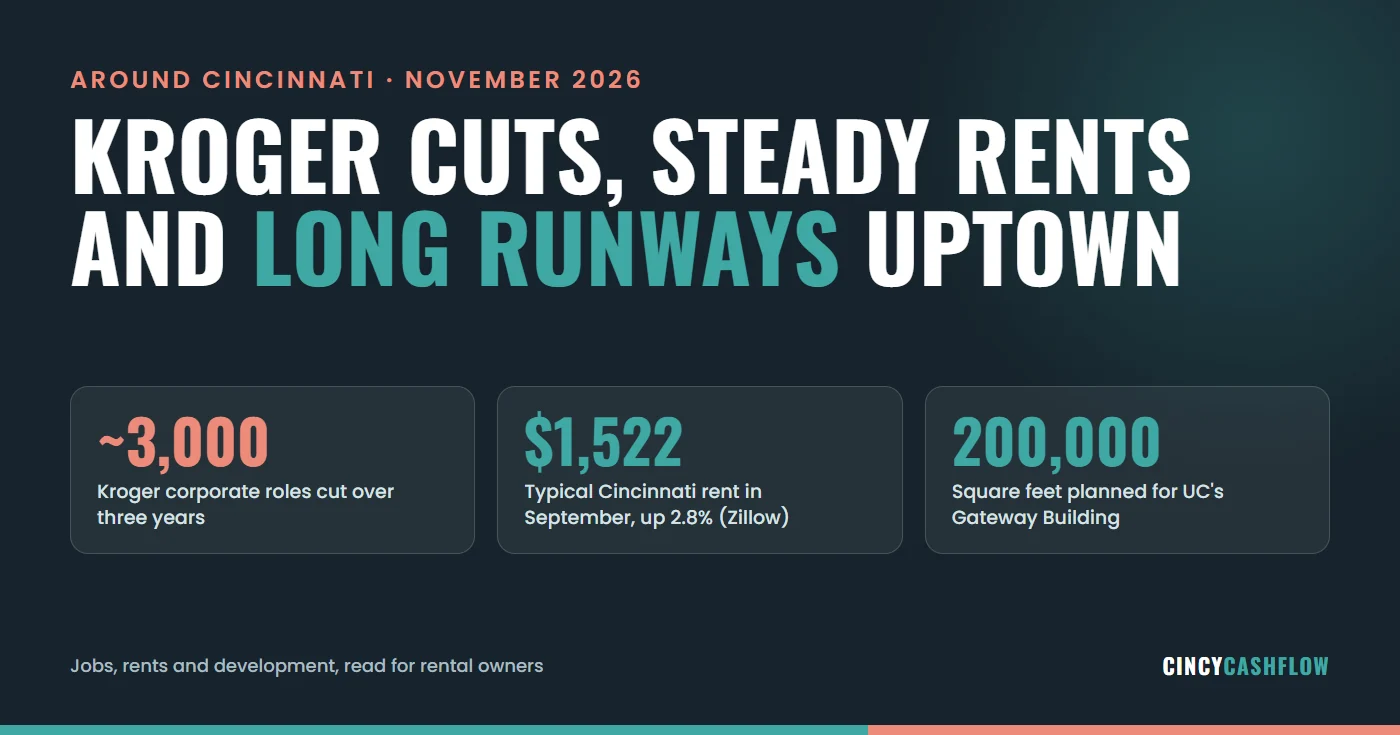
Cincinnati Market Update, November 2026: Kroger Cuts, Steady Rents and Long Runways Uptown
Kroger corporate cuts, flat rental demand with tight occupancy, UC's Gateway and Crosley projects, 3CDC in Over-the-Rhine and a Covington startup exit.
4 min readRead →
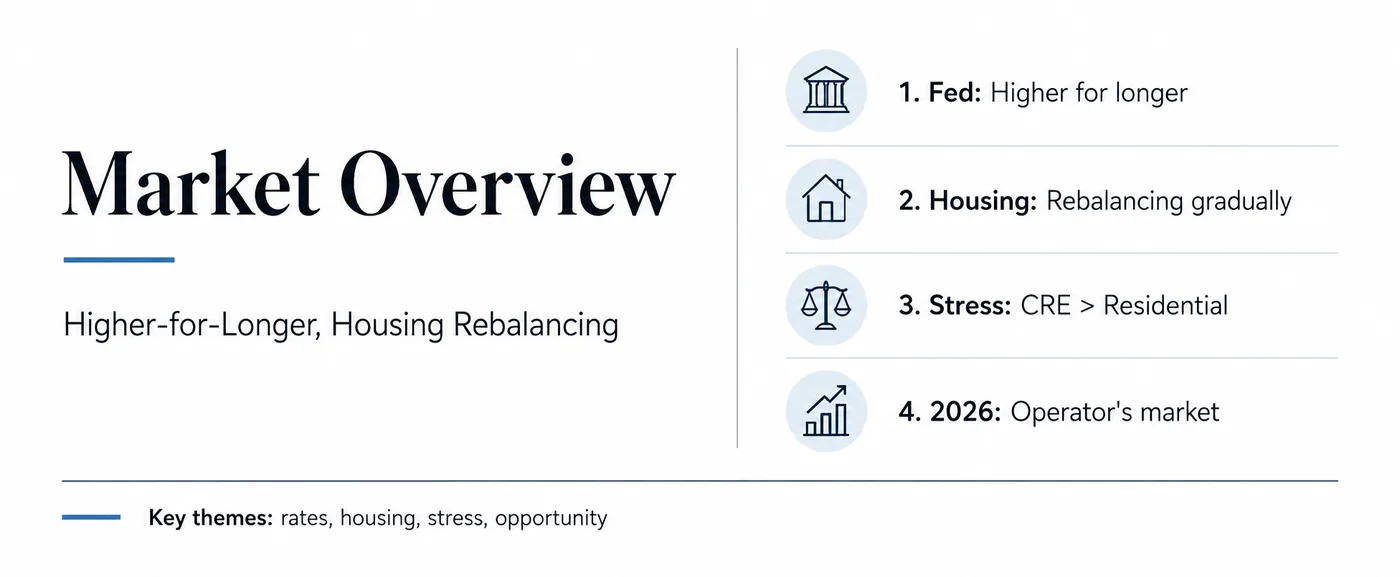
Higher for Longer: The Fed, Housing and Where Distress Is Showing Up
Rate relief is a possibility, not a plan. Where housing is rebalancing, where commercial real estate losses are realizing, and how operators should position.
2 min readRead →

Multifamily Insurance Costs: How to Underwrite Around Rising Premiums
Per-door insurance premiums jumped over the past 12 to 24 months. Stress-test renewals so a $300 per unit miss does not cost you $30,000 of NOI.
1 min readRead →