Cincinnati Multifamily From the Broker Side: Lessons From JD Schmerge
JD Schmerge has brokered multifamily deals in Greater Cincinnati for over eight and a half years. His first year as an owner-operator gave him more respect for the work than the previous eight combined.
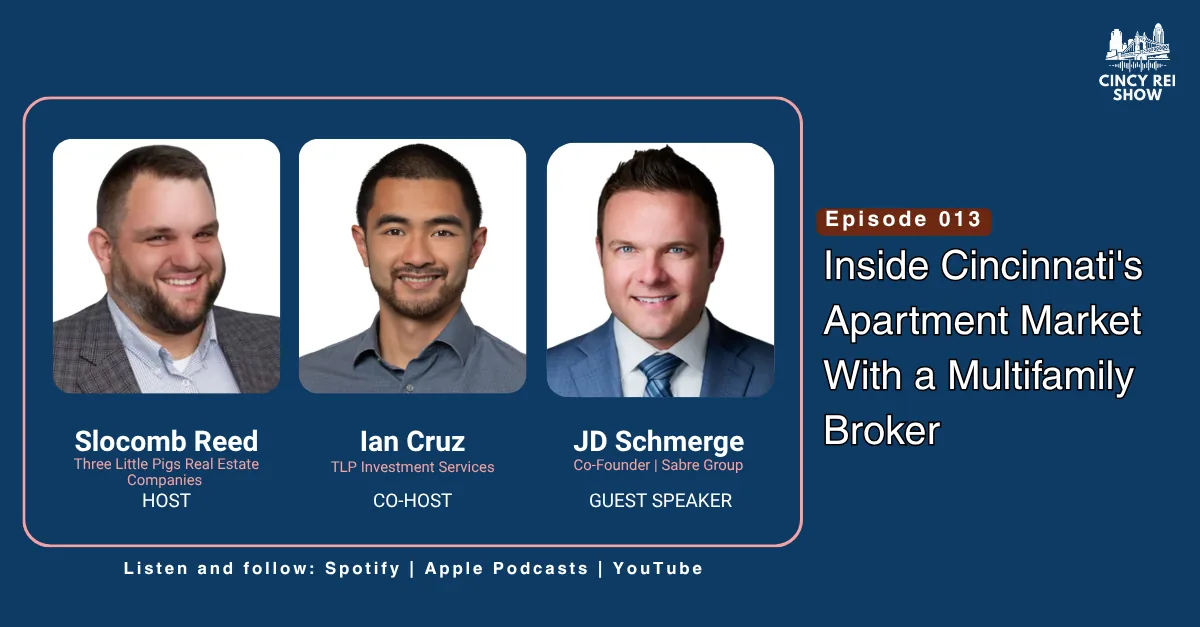
The Cincy REI Show episode features JD, co-founder of Sabre Group and a multifamily broker specializing in five- to 75-unit deals across Greater Cincinnati, who stepped to the ownership side in September 2024 and is now navigating the same market conditions he advises buyers on every day. The themes: low transaction volume, cap rate expansion, and a Covington seven-unit that doubled his insurance expectation on day one.
What the episode covers
- Why Cincinnati has not seen the distress that hit other markets. The city's historically higher seven to eight cap trading range gave operators breathing room that four and five cap markets did not have when debt hit six and a half percent.
- The two line items that have broken more underwriting models in the last 12 months than anything else: insurance and property taxes. JD's own Covington acquisition came in at more than double the seller's policy.
- Why 2025 was one of the lowest multifamily transaction volume years Cincinnati has seen, what that means for buyers now, and why JD would rather buy at 6.5% to 7% rates than in the 3% era, when winning meant paying a premium.
- The C-class bifurcation: why C-class vacancy has spiked more than any other asset class, why rent growth has plateaued at the bottom of the market, and what that means for unit renovation decisions in 2025 and 2026.
- The renovation threshold rule: buyers need at least 10% of units renovated at top-of-market rents to establish proof of concept, going above 70% leaves a shrinking buyer pool, and the deals that sell the dream consistently outperform the deals that sell in-place NOI.
- The Ohio versus Kentucky property tax divide: Cincinnati's 65% average increase in the 2023 triennial, the pending owner-occupant exemption bill and what it could mean for investor tax burdens, and why Hamilton County Auditor data remains one of the most underused tools in the market.
- Why the drop and swap (a 1031 exchange variant) is still largely intact in Cincinnati when Columbus and Cleveland have largely lost it, and which school districts are getting more aggressive about board of revision cases after recent sales.
Related reading
Insurance is the line item JD mentions first. Read how to underwrite around rising premiums for the stress-test approach. For another operator's view of building outside the core metro, read rural Ohio multifamily investing with Lee Yoder.
Listen on Spotify or Apple Podcasts.
Originally published in the Cincy Cash Flow Report on June 24, 2026.
Keep reading

Multifamily Insurance Costs: How to Underwrite Around Rising Premiums
Per-door insurance premiums jumped over the past 12 to 24 months. Stress-test renewals so a $300 per unit miss does not cost you $30,000 of NOI.
1 min readRead →

Rural Ohio Multifamily Investing: 930 Units With Lee Yoder
Lee Yoder of Threefold REI built 930 units across rural Ohio and northeast Indiana, buys near 8% cap rates and runs management in-house. Episode 9 highlights.
2 min readRead →

Cincinnati Market Update, April 2026: Building Boom and Higher-for-Longer Rates
A GE Aerospace commitment, the highest multifamily construction quarter in two years and a Fed on hold. What March meant for Cincinnati investors.
3 min readRead →