The Starter Home Gap: Why a Multifamily Investor Buys Entry-Level Homes
I love a good multifamily deal. So does everyone else. There is no shortage of buyers lined up for a Class B value-add apartment building in Cincinnati, and that crowd is what compresses returns. Our edge has never been winning the deal everyone wants. It comes from performing where we have a competitive advantage over others.
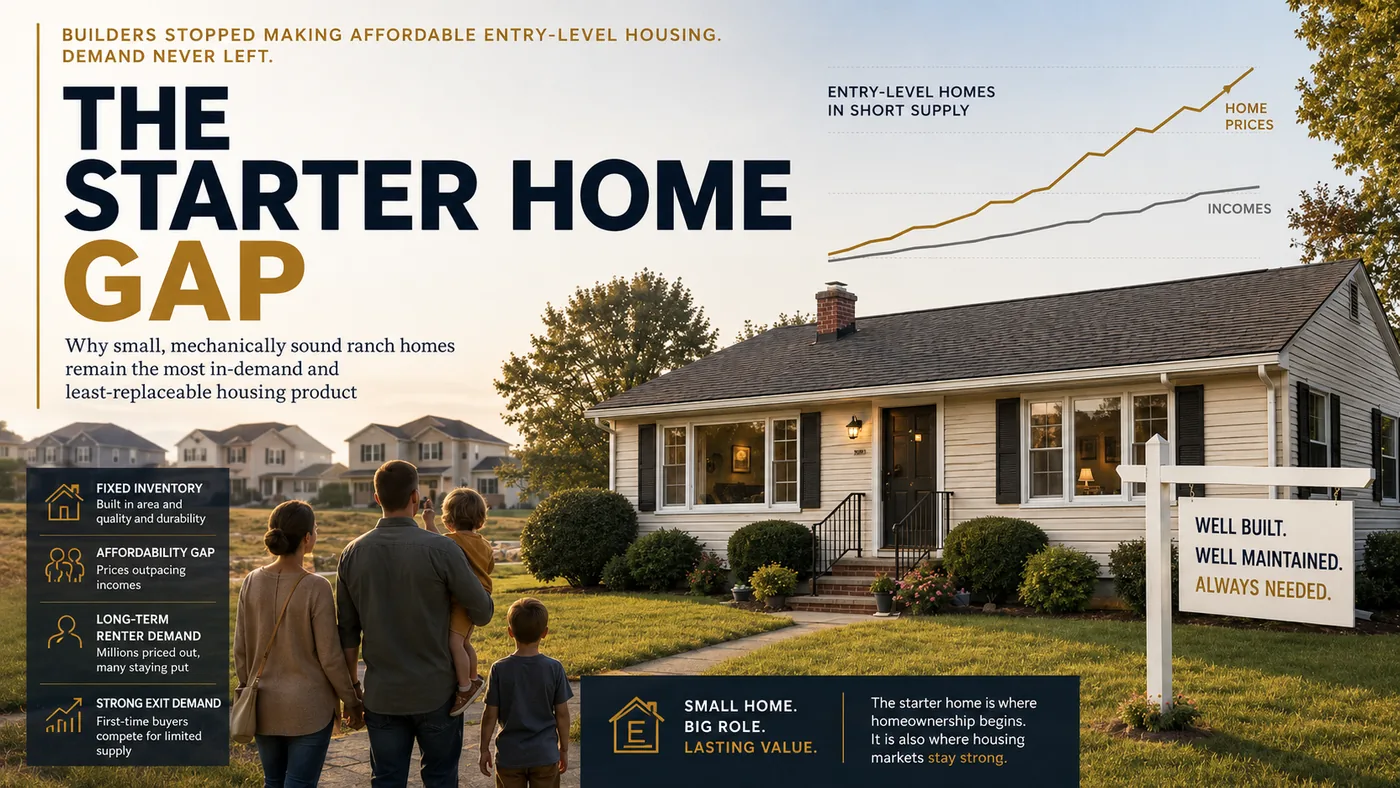
While the market piles into the same apartment listings, we pivoted to buying small, entry-level homes, renovating them, and selling them to owner-occupants at an affordable price. There is always an end buyer for an affordable home.
Most Cincinnati families shop in the $150,000 to $200,000 range, and at that price a renovated home qualifies for FHA financing, so a buyer needs about 3.5% down. That keeps the demand pool deep and the homes selling quickly.
The starter home stopped being built
Builders walked away from entry-level housing after 2008. A new three-bed ranch in most Midwest markets now prices in the low $300s, because that is the only number new construction pencils at. The 1940s starter home, small and simple and mechanically honest, cannot be reproduced at that price. That inventory is fixed. It is not growing, and a builder will never compete with it again.
Meanwhile, the family that wants to own one keeps falling further behind. The gap between what a workforce household can qualify for and what a new home costs widens every year.
That gap does two useful things at once for the owner of these homes:
- It creates a long-term renter who wants to own. They treat the house like it is theirs because functionally it is, and they stay. Long tenure and low turnover are worth more than a few extra dollars of rent.
- It guarantees a buyer on the way out. A renovated, mechanically sound starter home is the most in-demand and least-replaceable product in the market, sold to a first-time buyer with very few alternatives.
How to underwrite them
The homes are simple. The discipline is where the money is made or lost.
- Cash flow on day one. Underwrite each home to cash flow from the moment you own it, with 20%+ NOI growth. The cash flow should be real at takeover, not promised three years out.
- Tenants carry the utilities. Single-family tenants pay their own utilities, which keeps the expense ratio structurally lower than an apartment. Check whose name the utilities are in when you take over. Accounts left in a prior owner's name are a quiet margin you can recover with a phone call.
- Three comp sources, none of them gospel. Check every home against Zillow, Redfin, and a real broker, and underwrite to the conservative read. Automated values are directional, especially on older homes the algorithm assumes are in better shape than they are.
- A renovation number you have actually hit. Budget turns off real, recent crew costs, not a guess and not the seller's estimate. The operators who get burned trust a repair number they have never personally delivered.
Where the margin of safety lives
Buy below what the homes are worth today, and exit into a price tier the market is starving for.
- Buy below as-is value, not below a peak number from a few years ago that a seller likes to quote.
- Exit where new construction cannot reach you. If a builder's cheapest comparable three-bed is in the low $300s and you can deliver a renovated, sound home for a fraction of that, you are selling into the one tier where supply is fixed and demand keeps climbing.
- Respect the school district. Two homes four blocks apart can differ 10 to 20 percent in value on the district line. Higher-value districts tend to sell first, and higher cash-flow districts get held longer. The school district guide goes deeper.
One home, several ways to win
Each house is its own decision, so you are not locked into one exit for a whole portfolio. A single home can be:
- Sold early, where the profit is the acquisition discount.
- Renovated and sold to a first-time buyer.
- Offered rent-to-own to a tenant who qualifies on income but wants a runway to ownership. They get a path to owning, and you get a stable resident and an eventual buyer.
- Held for cash flow in a higher-yield district and sold individually down the road.
You pick the path at the time, based on the market in front of you, instead of committing up front.
The part that makes the rest hold up
When you put a good home into the hands of someone who plans to stay, you get the most durable real estate there is. The tenant treats it like an owner. The eventual buyer inherits a home the market is no longer building. The demand is real and the supply is fixed.
If you own rentals, look hardest at the homes you would be proud to hand to a family that wants to stay. Those keep paying you in every market.
For an example of this strategy in practice, read why we flip starter homes in Cincinnati.
Originally published in the Cincy Cash Flow Report on June 30, 2026.
Keep reading

Why We Flip Starter Homes in Cincinnati, Not Luxury Ones
Entry-level homes qualify for FHA financing, sell to owner-occupants and reward fundamentals over finishes. How Slocomb Reed's Cincinnati flips are built.
2 min readRead →

School Districts and Single-Family Rentals: The Variable Most Investors Misread
Assigned schools shape price, tenant tenure and exit demand. How to match a school district profile to a cash flow or appreciation strategy before you buy.
4 min readRead →
How to Value a Scattered-Site Portfolio: The Income Approach vs. Comps
A portfolio of houses is worth two numbers at once. How to run the income approach and comparable sales, and why to pay no more than the lower of the two.
5 min readRead →