How to Value a Scattered-Site Portfolio: The Income Approach vs. Comps
A portfolio of houses is not just worth the sum of the houses. It is worth two different numbers at the same time, and most buyers run the numbers one way.

Over the last several months my team underwrote scattered-site single-family and small-multifamily portfolios across the Midwest. We pulled the rent rolls, summed the value of every individual home, and ran each asking price against both ways of valuing real estate. Most of them were bad deals. Often they were marketed at a 7% cap rate while the underlying asset value sat below the price they were selling at.
Two ways to value the same building
Every property can be priced two ways, and good underwriting holds both at once.
The first is the income approach. What does it earn? Take the net operating income, which is the rent you actually collect minus what it really costs to run the place, and divide by a cap rate. A house that nets $10,000 a year at an 8% cap is worth $125,000. Investors and lenders think this way.
The second is the comp, or sales, approach. What did the house next door sell for? Find recent sales of similar homes and adjust for size, condition, and location. Owner-occupants, real estate agents, and appraisers think this way. Stack it up across a whole portfolio and you get the collateral value: the sum of what every house would fetch sold by itself.
The number on the cover page and the number underneath
A scattered-site portfolio gets marketed on a cap rate. The seller hands you an income figure, applies a cap rate, and quotes a price. What never makes it onto the cover page is how that price compares to the collateral underneath, the sum of what the homes are worth one at a time.
So we summed it ourselves on every deal, then set the asking price next to that number. Automated valuations are not reliable, but this works like the 50% rule: a screening test, not an absolute. The pattern was consistent. Most of these portfolios were being sold at a premium to the houses underneath them, and the cap rate said the package was worth more than the homes inside it.
Why the houses are worth more apart than together
When a scattered-site portfolio sells as a single package, the buyer pool shrinks to the handful of operators willing to manage dozens of addresses across a dozen ZIP codes. They want a discount for the headache. That is how a portfolio can sell for less than the sum of its own houses.
The houses are individually deeded, though. Each one can be sold by itself on the open market to an owner-occupant, a house-hacker, or a small investor. Retail buyers price on comps, and they pay retail.
The exit to look for: sell most of the single-family and duplex homes one at a time to local buyers over the hold, and keep the small multifamily for income at a conservative exit. Financing with no prepayment penalty means any house can be sold or refinanced the moment the math says to.
Buy at the bulk price and keep the option to sell at retail. If the deal underwrites on the income approach, cash flow arrives throughout, and the spread on sale only exists when the purchase price sat below the collateral.
Two floors sit underneath a deal like this:
- Below replacement cost. When the all-in basis is well under what it costs to build a comparable unit today, a competitor would have to spend more to create the same thing.
- Real spread of risk. No single property should be more than a small share of portfolio value, spread across many submarkets and several property types, so a bad furnace or a soft block barely moves the number.
Two more lessons
A great price means nothing if you cannot close. One 100+ unit Cincinnati portfolio fell out of contract four times. The buyer had it under contract for about six months, kept extending, and walked away after losing roughly $800,000 in earnest money because they could not raise the capital to fund it.
Automated comps are a gut check, not underwriting. Summing Zestimates is crude, and at the low-quality end those estimates run high because the algorithm has no idea the house needs a roof and two furnaces. A peer operator who runs a few hundred homes put it to me directly: renovation costs have roughly doubled in a couple of years, so be conservative with CapEx. Underwrite the condition, not the spreadsheet.
How to value a portfolio
Run both lenses, and refuse to pay above the lower of the two.
- Sum the collateral yourself. Pull a value on every address and add it up. If the asking price is above that number, the seller is charging a premium over the houses.
- Price the income on the rent you will actually collect, not the pro forma. Separate real lease-up upside from a hopeful growth assumption, and discount the seller's cap rate by the condition it is hiding.
- Verify the top of the stack with your own diligence once you can tour the properties.
- Respect the optionality. Individual deeds plus a clean loan give you exit flexibility most models ignore.
- Make sure you can fund it before you fall in love with it.
Like apartments, you have to review several deals to find one that works. Unlike apartments, far fewer portfolios are for sale and there are fewer buyers on the other side of the transaction. That is unfavorable when a seller does not need to sell. When deals do need to trade, only a handful of realistic buyers can close them, and we have focused on being one of those few.
Portfolios call for double the work: value the single-family homes on comps, value the multifamily on income, then run both lenses across the whole portfolio. Real estate is about finding your niche and doing the work.
See also why the friction in scattered-site portfolios creates the opportunity and what unit mix does to risk and exit.
Originally published in the Cincy Cash Flow Report on June 19, 2026.
Keep reading

Scattered-Site Portfolio Acquisitions: Why the Friction Creates the Opportunity
Scattered-site portfolios are hard to diligence, finance and renovate at once. Thin buyer pools and sellers who need certainty are why that friction pays.
2 min readRead →
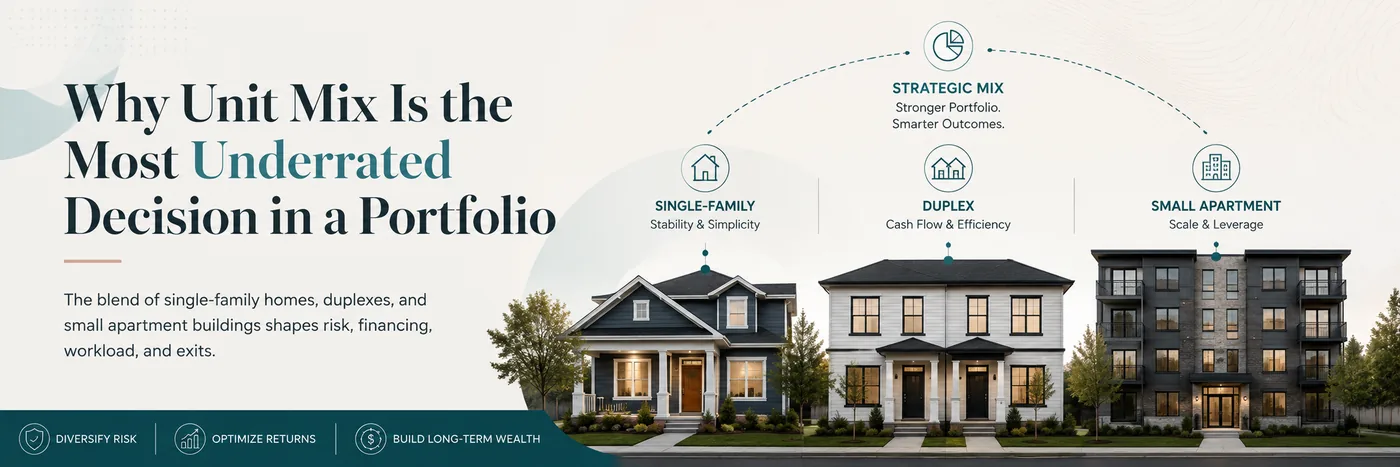
Unit Mix: The Most Underrated Decision in a Rental Portfolio
Single-family homes, duplexes and small apartments each do a different job. How unit mix sets your risk, financing, workload and exit.
3 min readRead →
Buying Scattered-Site Single-Family Portfolios When Others Can't
Why we buy scattered single-family portfolios at scale while much of the market moves the other way: fewer buyers, harder operations and a gap few firms fill.
2 min readRead →