Why We Flip Starter Homes in Cincinnati, Not Luxury Ones
"How do you create value flipping houses in this market?"

There are a lot of ways to do it well. High-end, designer-finish flips can be terrific projects in the right pocket. We tend to focus on the other end of the market: small, entry-level homes that we renovate and sell at an affordable price to an owner-occupant.
There is always an end buyer
The reason is simple. There is always an end buyer for an affordable home. Most Cincinnati families shop in the $150,000 to $200,000 range, and at that price a renovated home qualifies for FHA financing, so a buyer needs about 3.5% down.
That keeps the demand pool deep and the homes selling quickly, which is what you want when your return depends on getting in and back out cleanly.
Renovation scope stays honest
It also keeps the renovation honest. The dollars go toward what an actual homeowner cares about: a working HVAC system, a sound roof, new windows, and a functional kitchen. We solve for livable and durable, and that discipline protects the margin if the market softens.
Slocomb Reed has completed multiple fix-and-flip deals across Greater Cincinnati since 2022, with hold periods ranging from 5.7 to 13 months. He ran every one alongside managing a large rental portfolio.
What these deals have in common
- Every property in the sample was purchased under $170,000.
- Every one sits in an established Cincinnati neighborhood with a defined buyer pool, including Pleasant Ridge, Westwood, Winton Lake, and Ansel Heights. None of these are speculative areas. Buyers with conventional financing can get mortgages there, and demand is consistent.
- The renovation work skewed toward fundamentals: HVAC, roofing, flooring, windows, and appliances. No luxury finishes and no additions.
- The value creation came from bringing distressed properties up to market standard in markets where buyers are already active.
- Hold periods on the closed deals averaged 8.5 months, short enough to keep hard money carrying costs manageable and long enough to execute a real renovation instead of a surface-level cosmetic job.
The bigger picture
Slocomb's fix-and-flip activity runs parallel to TLP's core multifamily strategy. These deals show the same operating capacity we apply to larger portfolio acquisitions: sourcing below market, managing a general contractor efficiently, and exiting at or above after-repair value within a defined timeline.
For the demand side of this strategy, read The Starter Home Gap. To see how a Cincinnati investor built volume with four-families, read the cold-calling playbook.
Originally published in the Cincy Cash Flow Report on June 24, 2026.
Keep reading

The Starter Home Gap: Why a Multifamily Investor Buys Entry-Level Homes
Builders walked away from entry-level housing after 2008. Why renovated starter homes under $200,000 keep finding buyers, and how to underwrite them.
5 min readRead →
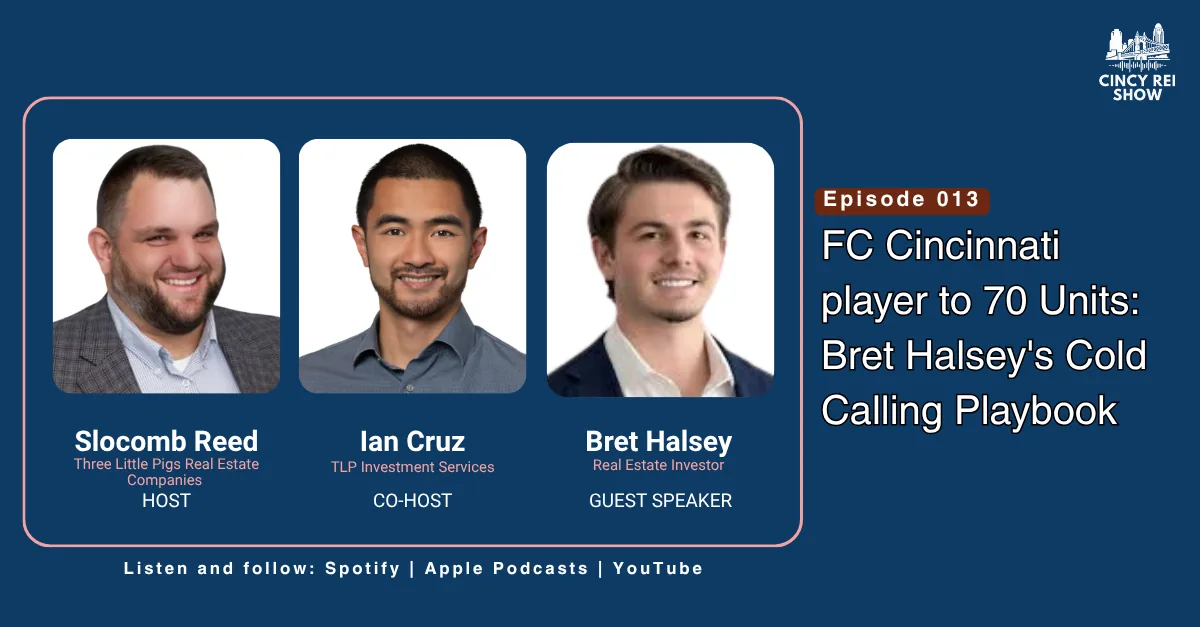
Four-Family Investing and Cold Calling: A Cincinnati Playbook From Bret Halsey
Former FC Cincinnati player Bret Halsey acquired 70+ units through direct-to-seller cold calling. His four-family playbook from Cincy REI Show Episode 13.
2 min readRead →

Cincinnati Hard Money Lending, Neighborhood by Neighborhood
Grant Smith of Sharper Capital Partners walked the Cincy REI Show through a live loan map of roughly 300 funded Cincinnati deals. Highlights from Episode 4.
2 min readRead →